1. Introduction
Intersections play a vital role in urban traffic management, as they directly affect roadway capacity, traffic flow continuity, and overall safety (Yaibok et al., 2024). Poorly designed or inadequately managed intersections often lead to congestion, excessive delays, and increased risk of accidents (Agyapong & Ojo, 2018). This issue is particularly evident in rapidly growing urban centers across Iraq, where rising population and expanding vehicle ownership have intensified pressure on existing traffic infrastructure (Jarah et al.,2019). Al-Diwaniyah City, a key urban center in southern Iraq, has witnessed a noticeable increase in traffic demand over the past decade(Al-Mrumudhi & Al-Obaedi, 2023). As a result, several intersections within the city suffer from recurrent congestion, especially during peak hours. One such intersection, located near [ Oruba intersection], experiences frequent delays and operational inefficiencies due to conflicting vehicle movements and outdated geometric design.
In the context of modern traffic engineering, traditional evaluation methods are no longer sufficient to address these complex challenges. Therefore, advanced simulation tools have become essential for conducting accurate and comprehensive assessments of traffic performance (Chao et al., 2020).
This study aims to evaluate the operational performance of the selected intersection in Al-Diwaniyah using SIDRA INTERSECTION software—a well-established micro-analytical traffic modeling tool known for its accuracy and detailed output. The current intersection configuration is analyzed and compared with several proposed alternatives based on key performance indicators, including Level of Service (LOS), average vehicle delay, and queue length. The goal is to identify the most effective design alternative that enhances intersection performance and reduces traffic congestion.
2. Literature Review
Numerous studies have investigated traffic performance at intersections using simulation-based analytical tools, with a growing emphasis on micro-analytical software to enhance evaluation accuracy. Akçelik (2015), the developer of SIDRA INTERSECTION, underscored the value of such tools in estimating intersection capacity, analyzing delays, and testing operational scenarios under varying traffic conditions.In the Iraqi context, Al-Mansoori et al. (2022) conducted a comprehensive analysis of four urban intersections in Basrah using SIDRA INTERSECTION. Their findings demonstrated that implementing optimized signal phasing could reduce average delays by up to 28 %, highlighting the effectiveness of strategic signal timing. Similarly, Al-Zubaidi and Abbas (2020) evaluated major intersections in Baghdad and concluded that adaptive signal control strategies were essential to mitigate increasing congestion, particularly during peak hours.
Internationally performed a case study in India, showing that the introduction of exclusive turn lanes significantly enhanced the Level of Service (LOS), often by one to two grades. These findings align with global research that emphasizes the utility of simulation models in forecasting the impacts of geometric and operational modifications on intersection performance. Building upon these insights, the present study applies SIDRA INTERSECTION to assess a key intersection in Al-Diwaniyah, a mid-sized city in Iraq. Given the scarcity of real-time traffic data in such urban centers, this research aims to propose cost-effective and data-efficient improvement strategies tailored to local traffic conditions.
3. Methodology
3.1 Study Area
The selected intersection (Al-Oruba intersection) in Al-Diwaniyah City serves as a critical node in the urban road network, experiencing significant traffic pressure during peak hours. The study location was surveyed over a one-week period, focusing on peak morning (7:30–8:30 AM) and evening (2:30–3:30 PM) times.
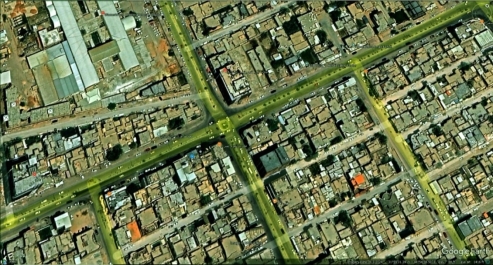
Fig. 1. An aerial image of the study area in Al-Diwaniyah City, Iraq
3.2 Data Collection
Manual traffic volume counts were conducted during weekday peak hours to record vehicular movements at the selected intersection. The data collection process included classifying vehicles by type (private and public) and by movement direction, including through movements, left turns, and right turns. In addition to traffic volumes, a comprehensive geometric survey of the intersection was carried out. Key parameters documented included the number of approach lanes, lane widths, lane configurations, signal timing and phasing, and pedestrian flow characteristics. These data provided a detailed understanding of both traffic behavior and intersection design, forming the basis for subsequent performance evaluation and improvement analysis.
Table 1
Intersection data in geometric design
|
Intersection Direction |
Road 1 width |
Road 2 width |
Median Width |
Sidewalk 1 Width |
Sidewalk 2 Width |
|
Governorate Bridge |
12m |
12m |
2m |
4m |
4m |
|
Second Arouba |
12m |
12m |
2m |
4m |
4m |
|
Maternity Hospital |
12m |
12m |
2m |
4m |
4m |
|
market |
12m |
12m |
2m |
4m |
4m |
Table 2
Intersection data in existing conditions
|
Intersection Direction |
Road 1 width |
Road 2 width |
Median Width |
Sidewalk 1 Width |
Sidewalk 2 Width |
|
Governorate Bridge |
10.15 m |
10.45 m |
1.90m |
4.48m |
5.96m |
|
Second Arouba |
9.80 m |
10.50m |
2.20m |
6.60m |
6.15m |
|
Maternity Hospital |
9.80 m |
9.70m |
1.90m |
4.30m |
2.40m |
|
market |
11.40m |
8.40m |
1.90m |
2.90m |
3.77m |
3.3 Analytical Tool
SIDRA INTERSECTION 9.0 was used for the simulation and performance analysis.
The morning peak hours were selected for data collection, as they exhibited higher traffic volumes compared to the evening period. The recorded traffic volumes during the morning session were analyzed, and the hour with the highest traffic demand—between 8:00 a.m. and 9:00 a.m.—was identified for detailed evaluation. Traffic volumes were aggregated at 15-minute intervals, and the collected data were subsequently input into the SIDRA INTERSECTION software for analysis.

Fig. 2. Photo for SIDRA INTER SECTION
Table 3
Traffic Volumes Recorded During the Morning Observation Period

Table 4
Traffic Volumes Recorded During the evening Observation Period
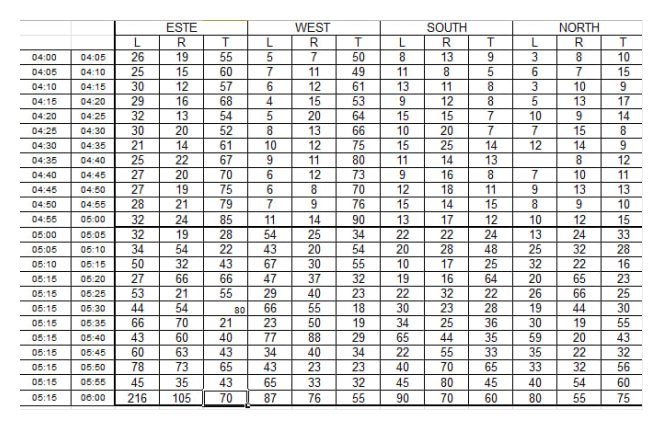
Table 5
The peak hours for Sunday and Tuesday that were analyzed and input into the SIDRA software
|
T |
R |
L |
T |
R |
L |
TIME |
|
1115 |
709 |
1070 |
1280 |
1263 |
756 |
9:00–8:00 |
|
1683 |
566 |
447 |
1634 |
1094 |
1131 |
9:00–8:00 |
4. Results and Discussion
The analysis conducted using SIDRA INTERSECTION 9.0 provided comprehensive insights into the operational performance of the studied intersection under existing and proposed conditions.
Under the existing conditions, the intersection exhibited an average control delay of 47.1 seconds per vehicle, corresponding to Level of Service (LOS) F, which indicates poor traffic performance during peak hours. The southbound left-turn movement emerged as the most critical, with an average delay exceeding 55 seconds and queue lengths reaching over 95 meters, significantly affecting upstream flow. Implementation of Scenario 1 —which involved adjusting traffic signal phasing and cycle lengths—resulted in a moderate improvement, reducing the average delay to 39.5 seconds and upgrading the LOS to C. Scenario 2 demonstrated the best overall performance. This scenario combined signal optimization with minor geometric enhancements such as additional left-turn bays and lane reallocation. As a result, the average vehicle delay dropped to 29.4 seconds, and the LOS improved to B. Additionally, queue lengths were reduced by approximately 40 % compared to the base case.
Scenario 3, which simulated a modern single-lane roundabout, achieved an average delay of 33.0 seconds with LOS C. Although this option offered reasonable performance improvements, it was found to be less feasible due to spatial constraints and the extensive reconfiguration required.
Among all alternatives, Scenario 2 provided the most effective and balanced solution, achieving significant delay reductions while remaining practical for implementation.
5. Discussion
The comparative analysis of the three proposed scenarios indicates that Scenario 2 is the most effective and feasible solution for improving intersection performance in Al-Diwaniyah City. Key advantages of this scenario include: A 37.6 % reduction in average delay compared to the existing conditions. Improvement in Level of Service from F to B, indicating enhanced operational efficiency.
Noticeable reduction in queue lengths across all approaches, thereby improving vehicle throughput.
Feasibility of implementation, requiring only low to moderate-cost interventions.
These findings are consistent with the results of Al-Mansoori et al. (2022), who observed significant delay reductions through signal optimization and minor geometric improvements. The results also support the conclusions of Akçelik (2015), who emphasized that small-scale geometric modifications combined with calibrated signal timings can lead to substantial improvements in urban intersection performance. While roundabouts are known to improve flow in certain conditions, they may be inappropriate for space-limited, mixed-traffic environments such as that of Al-Diwaniyah. Furthermore, driver unfamiliarity with roundabout operations may pose safety risks, especially during the early stages of implementation.
6. Conclusion and Recommendations
This study evaluated the operational performance of a signalized intersection in Al-Diwaniyah City, Iraq, utilizing real-world traffic data and simulation modeling through SIDRA INTERSECTION software. The analysis revealed that the existing configuration performs poorly, with an average control delay of 47.1 seconds per vehicle and a Level of Service (LOS) F, indicating significant congestion during peak hours.
To address these deficiencies, three alternative improvement scenarios were analyzed. Among them, Scenario 2—which integrates optimized signal timing with modest geometric enhancements—produced the most favorable results. This scenario reduced average delays by 37 %, improved LOS to Level B, and minimized queue lengths across all approaches. Importantly, the proposed improvements are both practical and cost-effective, requiring only minor infrastructure modifications, making them suitable for implementation by municipal authorities.
The study underscores the importance of applying simulation-based tools such as SIDRA INTERSECTION in urban traffic management. These tools enable transportation planners to evaluate various design alternatives accurately and make informed decisions to improve traffic efficiency.
Recommendations
Based on the findings, the following recommendations are proposed:
1. Adopt Scenario 2 as the preferred improvement strategy for the studied intersection, due to its balance between performance gains and feasibility.
2. Encourage traffic authorities in Al-Diwaniyah and similar cities to utilize simulation tools like SIDRA INTERSECTION in their planning and decision-making processes.
3. Extend future research to a network-level analysis, incorporating multiple intersections and evaluating the cumulative impact on traffic flow.
4. Include pedestrian and safety performance metrics in future studies to provide a more comprehensive assessment of intersection functionality.
5. By implementing targeted upgrades and leveraging simulation technologies, significant enhancements in traffic operations can be achieved, contributing to more efficient and safer urban mobility in Iraq.
References:
- Akçelik, R. (2015). SIDRA INTERSECTION User Guide. SIDRA SOLUTIONS.
- Highway Capacity Manual. (2010). Transportation Research Board.
- Al-Khafaji, H. A., & Hassan, A. K. (2021). Evaluation of LOS at Intersections. Journal of Engineering Science.
- Ministry of Construction and Housing. (2019). Road Design Manual — Iraq.
- Sisiopiku, V. P., & Oh, H. (2001). Evaluation of roundabout design alternatives. Journal of
- Transportation Engineering.
- Yaibok, C., Suwanno, P., Pornbunyanon, T., Kanjanakul, C., Luathep, P., & Fukuda, A. (2024). Improving urban intersection safety insights from simulation analysis. IATSS Research, 48(4), 523–536.
- Agyapong, F., & Ojo, T. K. (2018). Managing traffic congestion in the Accra central market, Ghana. Journal of Urban Management, 7(2), 85–96.
- Jarah, S. H. A., Zhou, B., Abdullah, R. J., Lu, Y., & Yu, W. (2019). Urbanization and urban sprawl issues in city structure: A case of the Sulaymaniah Iraqi Kurdistan Region. Sustainability, 11(2), 485.
- Chao, Q., Bi, H., Li, W., Mao, T., Wang, Z., Lin, M. C., & Deng, Z. (2020, February). A survey on visual traffic simulation: Models, evaluations, and applications in autonomous driving. In Computer Graphics Forum (Vol. 39, No. 1, pp. 287–308).
- Al-Mrumudhi, R. A., & Al-Obaedi, J. (2023, July). Estimating of parking load demand on Al-Diwaniyah city center. In AIP Conference Proceedings (Vol. 2787, No. 1). AIP Publishing.
- Alam, M. A., & Ahmed, F. (2013). Urban transport systems and congestion: a case study of indian cities. Transport and Communications Bulletin for Asia and the Pacific, 82, 33–43.