New technologies have an impact even in education. With the application of innovation in school life, the role of the teacher is changing, teachers have to adapt and learn new skills. Artificial intelligence, namely robots, has long been used in the modern rhythm of life, the question arises whether a robot can replace a teacher? The main purpose of this work is to answer this question, to compare the skills of a teacher and a robot. In addition, propose the idea of integrating a teacher and robotic collaboration.
Keywords: education, teacher, technologies, artificial intelligence, robots, skills, students, collaboration.
Introduction
Education is one of the most imperative activities of any individual. The key to education is the teacher, is the person who teaches something. The very first teachers are parents who give fundamental knowledge, instill moral values and concepts. The next teacher is the first teacher in the school, who gives the essential information of composing, perusing and understanding. The talent of a teacher lies in the ability to transfer knowledge to another person. «In order to teach another, it takes more intelligence than to learn yourself» said M. Montaigne, because teaching someone costs much more effort than understanding it yourself. In education, another significant part is the education system. The school education system is a system, the principles and laws on which the curriculum is drawn up in schools. [1] It is some educational modules, subjects, course readings, instructing strategies for which educating ought to allow information to students. It is the teacher who, alluding to the instruction framework, conducts lessons. With the development of the world, with the discovery of new technologies, the role of the teacher is distorted. New technologies are machines, equipment, things and services developed on the basis of the application of scientific knowledge, which is associated with engineering and applied sciences.
Technologies are developing every year, robots are improving, cybernetics is developing, machines are replacing workers, they are coming up with more and more new things to improve human life. Schools around the world are introducing computer programs into education, many schools have robotics sections, children use gadgets, diaries and magazines have long gone digital. Moreover, every year the position of automation of education is being strengthened. It still seems to many that artificial intelligence exists somewhere far away, in the laboratories of scientists and inventors. In fact, it is already a part of our life. The purpose of this article is to find out if artificial intelligence (robots) can replace teachers in the near future. Next, we will analyze such aspects as the use of technology in education, a comparison of a robot and a teacher.
Technology in education
New technologies have penetrated deeply into the educational sector, not only universities, but also schools and colleges. Now in the learning process, hybrid and blended learning are used, which interact with things like interactive whiteboards, digital libraries, flipped classrooms, etc. Because of this, the entire teaching process is changing, as well as the focus, now students are taking on an active role, which means a change from a passive conducting the lesson in a more active manner. All this affects the current teachers, because the standards are growing every day, the number of students and with them the needs are changing, the requirements from the state are increasing, and in addition to all this, the use of new technologies in education is one more issue for teachers. Consequently, the role of the teacher becomes more complex and responsible. This leads to the conclusion that a teacher in the modern world needs a balance of theoretical and practical knowledge.
Notoriously, modern technology helps to improve our lives and save us from wasting time. In education, teachers and students use technology to improve the quality of education, for the proper use of time. To start, it is needed to analyze what technologies and for what purpose use them in the education process.
—Using the Internet as an additional source of information
The use of the Internet has forever remained in education, because the Internet is now everywhere. Both students and teachers use the Internet to look for additional materials, learn and discover a lot of new things. In the 21st century, sitting in the library for a long time and looking for just information in one sentence is considered outlandish, because with the help of the network this can be done in a second and find even more useful information. However, there is another side of the coin where students use the internet to cheat and forge papers. [2]
—Use of projectors and visual effects
It is complicated to attract the attention of the students with words, teachers need to clearly show the subject with pictures or videos, it causes students to be more motivated and interested in the lesson. So in modern schools and universities, teachers use more visual effects, pictures, videos, and projectors, interactive whiteboards, various applications for presentations, infographics, and other techniques. [2]
—Using online services
It is not a secret that today's teachers, thanks to the Internet, have begun to set priorities correctly. For instance, there are a large number of different applications, services, online platforms in which teachers upload their already prepared materials, video explanations of the topic, or handouts. An example of such resources are platforms: Google classroom, Moodle, Unicraft, etc. Accordingly, they go through a practical part in the lessons, this helps to save time for both the teacher and the students. After all, history shows that a person learns and remembers most of all in practice. This method of conducting a lesson is called flipped classrooms.
In consequence, with the use of new technologies in education, the role of the teacher changes, becoming a connecting person between knowledge, new technologies and students. Therefore, in addition to basic skills, a modern teacher should have the following qualities [3]:
1) Ability to use projectors, computers, interactive whiteboards and other latest devices. For effective use, teachers need to have an idea of what these things give and how to use them. Now educators should be able to work with programs such as Excel, Word, PowerPoint and others. Services and devices make the work of teachers easier, because in the past they carried tons of notebooks and textbooks with them, and now it can all be placed in one laptop.
2) Communication skill. Now this skill is more important than ever, since practice is valued more than theory, the teacher must show the students everything in practice, create conditions where students can see or do what they are studying with their own eyes, and for this you need to be able to communicate and negotiate. For example, a chemistry teacher shows children an experiment, or introduces them to chemical plants where students see everything with their own eyes, for this needed to have good communication skills.
3) Thinking skills. Education becomes dependent on creativity, strategy and originality for competitiveness and knowledge enhancement. Finding solutions to problems, critical thinking, thinking out of the box, are all written by today's youth, but in order to teach them, teachers must have such qualities. The ability of a teacher to correctly find information in a large stream of sources also might be considered as thinking skills.
4) Child-raising skills. With the development of all these technologies, students should not become hardened, they should not accept technologies as eternal, because they can break at any moment. The teacher must educate them, show love and care, teach them to be hardworking and selfless. To instill moral and human values in students.
Artificial Intelligence-robots
Artificial intelligence (AI) is a system that can independently think, analyze and make certain decisions. In addition, a distinctive way is that it can learn. It is customary to perceive artificial intelligence in the form of chat bots, robot assistants and others. At present, there is an increase in the creation of various types of robots. For example, in South Korea there are robots that know English and can teach people. In Alaska, there are smart machines that help in government affairs. In 2010, Masan city began using robots to teach children English. Japanese scientists have developed a robot teacher named Saya, an elementary school science and technology teacher. Thus, it is possible to single out the main positive properties of artificial intelligence in the field of education.
Firstly, the elimination of bias in assessments. In school, the problem of unfair assessment by the teacher is often encountered, because the teacher cannot always objectively evaluate the work. Assessment using an impartial tool, such as AI, not only solves this problem, but also removes some of the burden with the teacher, thus the teacher has more time to interact with the students. [4]
Secondly, robots help in administrative work. Write a report, send feedback to students and parents, and other tasks that take teachers a lot of time.
Third, help students. The use of artificial intelligence and machine learning technologies allows the creation of training programs for each individual student, taking into account his characteristics and needs.
Fourth, increase motivation for learning. If teachers learn how to use modern technologies effectively, this can significantly increase the level of motivation of students, their knowledge of interest in new knowledge and achievements.
Fifth, take care of the emotional health of students. AI is suitable for assessing all emotions, movements of a teenager, so that it can calculate a specific theme, width. Also, AI is designed to search for troubled teenagers, a select researcher from Johns Hopkins University in Baltimore (USA) has developed a new machine learning algorithm that accurately identifies people at high risk for suicidal ideation in school surveys.
A small study was conducted on how students think about replacing teachers with robots. The questionnaire showed that less than half of the people surveyed, namely 13, believe that robots can teach, while the rest do not(figure1). A significant percentage of respondents (83.3 %) do not think that robots can replace teachers in the education system(figure 2). This study shows that students do not believe and are not ready to replace the teacher with artificial intelligence.
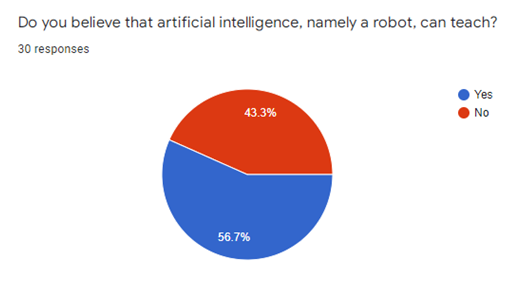
Fig. 1
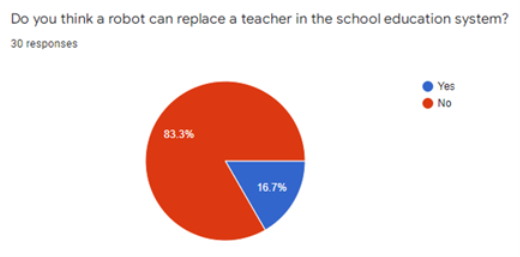
Fig. 2
Despite the above positive aspects of robots, there are a large number of negative aspects. 1- Robots are unemotional creatures. Robots do not have a heart and soul, scientists are not able to introduce into artificial intelligence the ability to empathize and feel. Machines without feelings will not be able to fully convey information to students, they will not understand the feelings of students.
2-Robots do not inspire confidence in students. Now there are a lot of asocial students who do not easily trust people. When the teacher himself works with a student, there is a connection, respect and trust between them. Machines will not be able to understand students, they will not be able to share good advice.
3-Robots do not educate. The school not only gives knowledge, but also educates students, instills moral and human qualities. Only a teacher will be able to show, tell and share life tips that will help students in the future.
In the age of digital development, the solution to this issue may be the integration of the work of teachers and robots. Collaboration has never been poor quality. This is how artificial intelligence can be properly integrated into school life. [5] Such work as grading, compiling topics for analysis, finding additional information on the Internet, and explaining theoretical material can be left to the machine. Therefore, conversations, checking oral homework, help in solving problems and problems, psychological or moral support, relationships with parents and other matters can be left to the teacher. In this way, you can correctly distribute the work between the robot and the teacher, thereby allowing you to work in a cooperative.
Conclusion
A teacher is a person who helps students in understanding and accepting, therefore, the importance of a teacher, both in the past and in the present, cannot be ignored or downplayed. The development of new technologies has led us to artificial intelligence, this is a system that can independently think, analyze and accept certain solutions. The main purpose of this written work was to compare a teacher and a robot and answer the question «Can a robot replace a teacher in the near future?" Many aspects were considered, namely, what technologies are currently used in modern schools, what skills a modern teacher needs, what skills positive and negative aspects of robot teachers. They came to the conclusion that robots do not have a heart, so they cannot have a connection with students. Quality education and conscious upbringing is the main goal of modern teachers. How can a robot without a heart feel the pain of a student, give him motivation, or even understand his problem? On the other hand, teachers can spend more time with students while robots do paperwork. The blending of technology and teaching will have a positive effect on students and teachers. Teachers will have more free time and be able to explain topics that the students did not understand. Robots will also do the job of a teacher because they will check student exams, plan lessons and use creative methods. Also, they may know the subject better than the teacher, so they will be good helpers. In conclusion, the topic of education is very sensitive and a blended approach to learning would be the best solution.
References:
- Hoggart, R. (2002). Peoples and cultures. Oxford Encyclopedia. Infra-M.
- Raja,R.,Nagasubramani,P. C.(2018). Impact of modern technology in education. Phoenix Research Publishers.
- Mrs. Manisha Sharma (2017). Teacher in a Digital Era. Global Journals Inc.USA.
- Kiseleva,N.(2021).Can a robot replace a teacher?
- Ian,P.(2005).BT Technology Timeline