Traditional method of education is about studying in the classroom and memorizing a wealth of information. Even though most of the schools use this way of teaching, a modern world requires methods that are focused not only on exposing students to knowledge but also on developing skills essential to succeed in a rapidly changing world. The Project-Based Learning (PBL) is an approach based on gaining knowledge via interacting with real-world problems and questions. It is used all over the world to teach students in different fields and help them acquire 21st century skills. The aim of the research is to investigate whether the PBL is effective in teaching chemistry to middle school students by using the recent research of scientists. Moreover, this paper proposes the PBL idea for middle school chemistry.
Keywords: education, teaching methods, project-based learning, PBL, chemistry, middle school.
Introduction
In middle school students begin to explore the fundamental sciences such as mathematics, physics, astronomy, biology and chemistry. As defined in the online dictionary by Merriam-Webster, chemistry is a science that deals with the composition, structure, and properties of substances and with the transformations that they undergo. Studying chemistry, as most of the science subjects, is about memorizing a wealth of information and applying mathematical and critical thinking skills to solve the problems. At the beginning it can be difficult for students to analyze all the data and to remember it. Moreover, it may force pupils to cram for their exams, hence leading to poor results. Therefore, the most efficient way to study science is to learn its aspects in practice and the project-based learning (PBL) is a useful method to deal with it.
According to Schuetz, Project-Based learning is a teaching method based on giving students an opportunity to gain knowledge through doing projects around real-world problems [1]. The PBL requires students to search for the information, work in a team and brainstorm the ideas to solve a given problem by themselves. Some people are perplexed by the fact that students need to study on their own and that teachers cannot control whether pupils understand the materials. As it was shown by Lathram, B. et al., these fallacies are based on the myths that students certainly should be “taught” by their teachers. However, researches show that the learning outcome of studying practically is threefold of that of studying in a traditional way [3]. When I was studying in my middle school we were also taught through project-based learning which helped me to memorize the properties of elements in a periodic table. I have taken an interest in the usefulness of this approach and as a future chemistry teacher I am pleased to explore this topic. This article will first explain what project-based learning is and go through the key features of it. Secondly, the article will examine the benefits of PBL in teaching chemistry. Finally, my own idea for project-based learning in chemistry science will be suggested.
Project-Based Learning
Project-Based Learning is a powerful way to learn new things and remember them for a long time. In other words, it is a form of learning by solving a real-world problem or question. The business magnate Elon Musk once said: “Our brain has evolved to discard information that it thinks has irrelevance”. It describes the obvious effectiveness of the PBL well. Learning by solving a specific problem such as building an airplane or creating a navigation app by means of existing knowledge and getting new is much more engaging than learning a new topic itself. For instance, by making a model of volcano students can learn about reactions involving baking soda and vinegar in an interesting way.
According to John Larmer, if done well, the PBL can yield great results. To help teachers organize an effective project Buck Institute for Education created the “Golden Standard of PBL”, which consists of 7 concepts essential for project design. The first element is a “challenging problem or question” that should be chosen well in order to engage children. They stay motivated throughout the learning process when they gain knowledge to answer particular questions, not just to pass exams. The next concept is “sustained inquiry” which is described as searching for information in different ways, such as interviewing experts along with searching websites. It teaches students to ask the right questions and, therefore, develops creativity and thinking skills. The third feature is an “authenticity”, mainly the authenticity of context. It means that students solve a real-world problem that people face in the world by using the real-world processes, such as the experiments. This feature is followed by the “student voice and choice” concept, which stands for students’ ability to control the process, choose the appropriate materials, divide the responsibilities in a team and create the final product by themselves. Moreover, they should have an opportunity to express their ideas and make them real. The fifth element of the golden standard is a “reflection” that is vital for learning. When students reflect on gained knowledge they start to think about the ways this information can be used in their projects. Furthermore, analysis of ready projects helps to make the next work even better. The sixth concept called “critique and revision” is about being comfortable with receiving feedback and being ready to revise your project. The last feature of a well-designed project is the “public project”. When students present their work to a big audience, they remain motivated and engaged in practicing as they feel their contribution to solving global problems [2].
Overall, the PBL enhances students’ attitudes toward education and improves their results only if done well and the “Golden Standard of PBL” is a good guide to achieve it.
The benefits of PBL in teaching chemistry
As mentioned in a previous paragraph, project-based learning is an efficient way to study science. A major reason for the effectiveness of this method is the fact that students stay more motivated while investigating the topic. Students should be ‘aggressive’ with difficult problems or concepts in order to succeed and not give up easily. Therefore, properly selected driving questions that will meet the interests of students is essential in organization and driving the activities. Moreover, students stay motivated when they feel that their work, their contribution is valuable in solving global issues. The motivation is important to increase students’ efforts to study, resulting in significant progress.
Chemistry requires hard thinking and great efforts to understand concepts, because they are the basics of problem solving. Analysis and problem solving are the activities in which you must bring together your understanding of concepts, learned material and your math skills. This leads to the next point: “reasoning ability”. It is shown in a study of Turkish scientists Ozlem Koray and Abdullah Koray called “The effectiveness of PBL supported with computer simulations on reasoning ability” (2013) that project works have a positive effect on developing analytical skills. They conducted a study by using two groups of students. A group that was taught by PBL had to think about problems related to “Buoyant force in liquid and gases”, find the solutions as many as they could and prove the most effective one experimentally. The second group was instructed about the same topic by traditional methods of teaching. In order to see the progress of each group The Test of Logical Thinking (TOTL) was used as pre- and post-tests.
Table 1
Independent t-test results for groups’ reasoning ability scores [4]
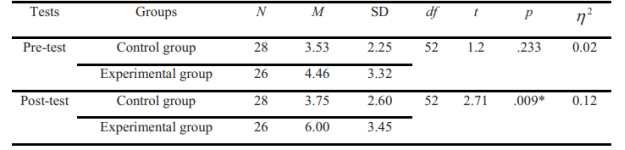
It is clear from Table 1 that the magnitude of the difference in the scores (last column) of pre-test was relatively small, accounting for only 0.02. It means that students’ reasoning ability level in both groups was similar to each other at the beginning. However, the magnitude of the difference at post-test was medium, increasing almost six times. This indicates that the experimental group, which was taught by PBL, demonstrated more increase in reasoning ability than the control group students.
The results of the study can be summarized as clear evidence of effectiveness of PBL on developing analytical skills.
The Project-Based Learning along with developing essential chemistry skills, increases the results of students in studying subjects. This leads to the third and last point: “enhancement of learning outcomes”. The study called “Project-Based Learning in the secondary chemistry classroom” conducted by Elizabeth Crane (2015) is the clear evidence of it. The research was implemented in North Farmington High School of Michigan. Students were asked to research the properties, atomic structure and common uses of a selected element in order to answer the driving question: “How do the properties and/or structure of an element (or compound) impact how we use it?”. On the first and last days of class, students completed an 18 items test, which were used in the analysis of the research.
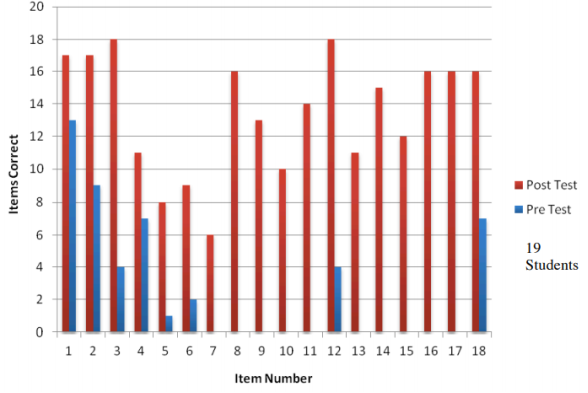
Fig. 1. Item Analysis of Pre-Test and Post-Test Responses [5]
The bar graph (Figure1) illustrates the relatively high pre-test scores on first items. This indicates that students started the course with knowledge of basic definitions and were also familiar with using the periodic table. On the other hand, the scores of post-test are high in all subjects.
The results of this study support the statement that the use of project-based learning improves students’ understanding and achievements in the subject.
Idea for PBL in teaching chemistry science
Motivation is the “engine” of any learning process and the PBL is not an exception. Therefore, the driving question or problem should encourage students to study and allow them to apply their skills and ideas to solve the problem. The driving question of an idea for project-based learning in teaching chemistry to middle school students that I came up with is “How do the properties and structure of a Carbon element impact the Climate Change?”. Students will be needed to find out the properties, the structure of a Carbon atom, the Carbon cycle, and its impact on global climate change. At the end of the project they’re expected to present an infographic describing the environmental impact of Carbon. Activities, such as making a model of a carbon atom and creating the visuals with the properties of an element, will be used for assessment of the gained knowledge.
I tried to think of a topic that is urgent and popular nowadays. Global warming is changing the climate and, therefore, leading to the almost irreversible consequences such as melting of icebergs, increase of the ocean surface temperature, increased risk of plants and animals extinction. This project will help students to not only gain knowledge in chemistry science, but also to become aware of this issue.
Since I’m not a teacher yet, I conducted a survey to obtain feedback on this idea. It was completed by 29 respondents, including 9 students of 7–8 grade and 20 future chemistry teachers.
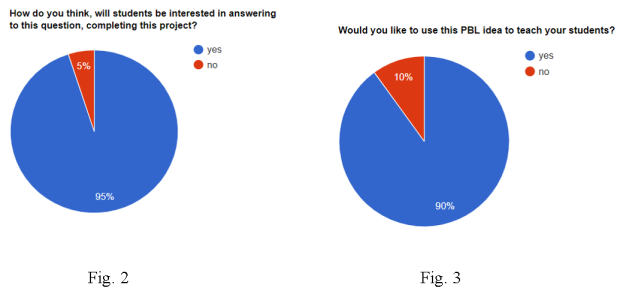
These pie charts show the responses of the future chemistry teachers. It is clear that most of the respondents (95 %) think that this project will engage students in studying and as the future teachers most of them (90 %) would like to use it in teaching chemistry. Moreover, all of the respondents believe that this PBL will be effective in teaching atomic structure and properties of Carbon to students.
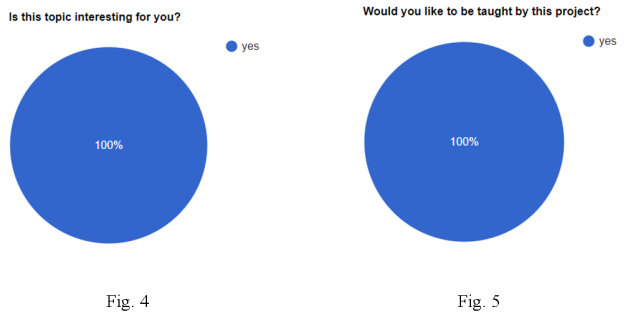
Figure 4 and Figure 5 illustrate the responses of students of 7–8 grade. As it is shown in the pie charts, students are open to this method of teaching and are interested in selected topics.
Overall, the results of this study can be interpreted as the evidence of effectiveness of this approach and that driving questions are appropriate to motivate and teach students.
Conclusion
Traditional method of teaching is definitely the one we’re used to and feel comfortable about. However, the rapidly changing today’s world requires revision of our education system. An ambitious and curious student should be able to think critically, communicate with people and be flexible in order to succeed in a continually changing environment. The project-based learning is a fascinating process of studying a subject which is driven by a real-world problem or question that motivates students to learn throughout the project.
The PBL is used by educators in various fields all over the globe. As it was previously mentioned, PBL is an effective approach to teach chemistry. Students can feel themselves as the real scientists by performing their work. For instance, they can collect data, make experiments, conclude their findings and share discoveries with the audience in the same way as scientists do. Learning in this way facilitates active participation in the learning process, group work skills and information literacy of the students. Moreover, it is important for the teacher to choose an appropriate topic that will engage students to work. It can be related to the current global problems or to the subject that students are interested in.
In conclusion, it is worth repeating that well-organized project-based learning can increase the capacity of teaching science subjects, such as chemistry. Indeed, in addition to gaining knowledge in the main subject, the PBL helps to acquire 21 st century skills.
References:
- Schuetz, R. (2018). Project-Based Learning: Benefits, Examples, and Resources. Retrieved March 13, 2021, from https://www.schoology.com/blog/project-based-learning-pbl-benefits-examples-and-resources
- Larmer, J., Mergendoller, J., Boss, S. (2019). Gold Standard PBL: Essential Project Design Elements. Retrieved May 10, 2021, from https://my.pblworks.org/system/files/documents/Gold_Standard_PBL_Essential_v2019.pdf
- Lathram, B., Lenz, B., Vander Ark, T. (2016). Preparing students for a project-based world.
- Koray, O., Koray, A. (2013). The effectiveness of problem-based learning supported with computer simulations on reasoning ability.Turkey: Elsevier
- Crane, E.L. (2015). Project-based learning in the secondary chemistry classroom.