The article deals with the new competence model of the graduate of the university. The competence model of a graduate of a leading university reflecting the needs of the modern knowledge society revealed. The concept of Trendsetter as innovator and creative specialist with entrepreneurial skills is introduced. The important role of higher education development is seen in providing students with an opportunity to develop professionality and creative skills.
Keywords: trendsetter, graduate model, competence, the key of knowledge.
The period of the end of the 20th century and the beginning of the 21st century was a new stage of world socio-economic development connected with the formation of a global knowledge society. The ability to produce and use knowledge becomes the most important factor of development, the key competitive advantage of both individual organizations and entire state institutions. The knowledge-based economy relies more on the use of ideas than physical resources, and on the introduction of high technology, rather than on the processing of raw materials and the exploitation of cheap Laboure. Knowledge is produced and used by society. The leading States of the world identify higher education institutions as the main actors in adapting national socio-economic systems to the new conditions of a global knowledge society. The European Union Innovation Agenda considers knowledge as a new strategic factor in production [1]. Production, transfer and practical application of knowledge by leading universities have a primary role in the processes of economic reorientation and further social and economic development. In the United States, research universities are also seen as national leaders on the way out of economic crisis. Those who finance them, as well as society as a whole, expect effective leadership in innovative development from them [2]. n the State Program of the Republic of Kazakhstan — The Development of Science and Technology for 2013- 2020 years as a State priority is marked «the formation of a globally competitive national innovation system, Comprising as one of the main elements an integrated research and development system with higher education, Flexibly responsive to economic requests, as well as engineering business, Innovation infrastructure, intellectual property market institutions, mechanisms to stimulate innovation, etc.» [3].
Large-scale changes in the social and economic environment force universities around the world to look for new models of their own development that are adequate to the external conditions and to make appropriate changes in the established forms of graduate training. It is recognized that the German, or Humboldt, model of the university, which has dominated since the 19th century, does not offer exhaustive answers to the challenges of modern innovative society. The Humboldt model suggests that university scientists are funded by the state, that they produce basic mental knowledge in the conditions of academic freedom, and that they communicate this knowledge to students in optimal volumes and forms from the point of view of teachers. In the context of the formalization of the global knowledge economy, the concept of a market-oriented innovative university based on a triangle of knowledge (education, science and innovation) has become dominant.
The current changes are even larger because of their global nature and the greater number of participants — both people and institutions of higher education around the world [4].
The experience of advanced countries shows that large industrial corporations are the real engine of world innovative development. Private sector enterprises are the main source of innovation in OECD countries and in rapidly growing economies driven by the need to ensure their own market competitiveness [7]. Principal innovations in modern conditions (especially in the sectors that determine the pace of development of the world industry: information and communication technologies, nanotechnology, biotechnology) are usually very expensive, which is only under the power of large investors, giant industrial enterprises. It should be recognized that universal companies will not be able to defeat corporations in the foreign market. This new understanding of social reality has come very recently and is struggling to break its way against the background of enthusiast and dreams about the possible economic impact of the development of university innovation.
A realistic assessment of the capacity of universities to transfer technology does not mean that this function becomes unnecessary, and efforts to develop it should be held back to some extent. The new functional model of the university (model innovative university based on the «triangle of knowledge») is firmly in life and is the main paradigm of higher school development. It is only that if we consider university technology transfer as the main contribution of the university to the creation of an innovative economy, we put leading universities in a futile situation of «catching-up modernization», when they will try to become something that in essence cannot become, namely, market industrial enterprises.
What can universities offer to develop the knowledge economy? What is the unique competitive advantage of universities, which will allow them to retain the role of the participants of social and economic development in the new global context? In our view, this advantage lies in the realization of the historical function of universities — the production of human capital, but of human capital of fundamentally new quality. The innovation economy changes the needs of the international Laboure market, imposes requirements on citizens, including knowledge and competence for their daily life in the knowledge society. Training of personnel capable of meeting these new demands is becoming a key task of the higher education system.
International practice shows that large multinational companies view their cooperation with the world 's leading universities primarily as a means of selecting talented students and nurturing their future employees, who should be highly educated effective innovation professionals [5]. Universities should give the knowledge economy the main resource of their development — highly qualified creative specialists trained in innovative entrepreneurship, or, in other words, trendsetters. It is important to note that, speaking of trendsetters, we mean people who are deeply versed in a particular field of knowledge (which is their main educational specialization), but also have a set of pre-adoption skills and competences, which are key to the success of a specialist in the Laboure market of the global knowledge economy. We identified a university graduate as someone trying to turn a new idea or invention into innovation. At the same time knowledge is very often general-purpose and does not contain know-how, and the decisive factor of successful development of companies will be entrepreneurial qualities of their creation.
There are many definitions of “employability.” Indeed, its components may differ widely between areas of work. There is a clear set of definable competencies, in terms of things that a person knows how to do or facts that they have committed to memory, in areas like medicine, nursing, law and accountancy. In some other fields, habits of thinking, the ability to take a critical approach to a problem and then choose and implement the right research strategy to solve it, are more important than functional competency or facts. In addition, no matter how closely allied universities and employers are, there will always be tensions when it comes to competencies, skills and attitudes towards work issues. Employers tend to want things to be done their way, while universities expect students to develop and exercise critical judgment. Either employers or universities may be ahead in terms of technical or theoretical innovation.
Creating influential innovation requires an entrepreneurial warehouse of mind that helps to see big problems as big opportunities. The entrepreneurial approach is an indispensable ingredient of the innovation process, a special mechanism for solving problems, and an effective complement to basic methods of basic humanitarian and natural science knowledge. Entrepreneurship should not be regarded solely as net commercialization or management. Fundamental entrepreneurial thinking and related techniques do not depend on what your interests and dreams are [2]. Competencies and skills in the field of innovative entrepreneurship in the global knowledge economy are necessary both for representatives of natural and engineering sciences, as well as for humanitarians and social scientists. They become general professional, necessary for most professions related to intellectual work.
Innovation in education is a priority for states interested in systemic economic development, strengthening the role of science, improving the welfare of the population and reducing social tensions. It is obvious that stagnation in the teaching system is a negative phenomenon affecting the state and society, leading to the accumulation of systemic problems at all levels of existence. Innovation is a broad concept. In terms of education, it is the use of new technological and methodological research and the timely replacement of outdated standards. By analyzing innovations in education, examples can be found in studies. With their help, the student learns to identify the relevance of the problem, determine the ways to solve it, choose methods for experiment, conduct experiments, make logical conclusions, determine the prospects for further research in this field. Among the main methods and techniques required for research: experiments, conversations, modeling situations, didactic games. At present, leading higher education institutions hold competitions and conferences for beginners, supported by scientists. Students get their first experience in public defending the experiments and scientific discussion.
Trendetter — an innovator who perceives new ideas or trends earlier than others and adopts innovation in mass usage by his example.
Today, graduates of the world 's leading universities should not only be professionals in their knowledge industry, but also be able to identify opportunities, understand the action of market forces, be able to implement the commercialization of new products, as well as possess the leadership and communication skills so necessary for the effective defense of their own ideas. The availability of entrepreneurial knowledge and skills in the global innovation economy has become a critical factor in the success of the Laboure market.
Taking into account the specifics of the global knowledge society and the emerging new challenges for higher education, we propose a new approach to the interpretation of the functional model of the university and the competence model of its graduate on the basis of the «knowledge triangle or tetrahedron». As before, we see basic and applied research and education as the basis for the development of innovation at the university. At the same time, we propose to change the setting of priorities in understanding the tasks of developing university innovation.
Researchers most often identify professional concepts in relation to competence as «ability» and «willingness». In our opinion, the phenomenon of a person's readiness for activity includes the ability (ability) to carry out this activity and the motive (desire) for its realization. Professional competence of a person as readiness to mobilize personal resources (organized into a system of knowledge, skills, abilities and personal qualities) necessary for effective solution of professional tasks in typical and non-standard situations includes special professional competences and key competences as an integrated result of education. The former represent a person's ability to effectively solve a certain class of professional tasks (design, diagnostic, etc.) adequately to a specific situation, while the latter represent invariants regarding the type and type of professional activity. The former can be formed (and evaluated) within the framework of one or more academic subjects, while the latter are fundamentally superficial. The development of both is connected with the process of human «ability», i.e., mastering the way of activity (ability development).
Competencies do not exclude knowledge, skills, and abilities, although they are fundamentally different from each other. From knowledge — by the fact that they exist in the form of activity, not only information about it. From skills — the fact that the competences can be applied to solving different tasks and in different situations (have the property of transfer). From skills — by the fact that they are conscious and not automated, which allows a person to act not only in a typical situation, but also in a non-standard one. Thus, professional competence is a person's possession of a certain set of special and key competences, including a value attitude to the professional situation within which he or she acts.
At the same time, we are convinced that the most important role of the university innovation infrastructure is that it is a «laboratory base» for training entrepreneurs capable of effectively developing innovation activities in their fields of knowledge, a tool for developing students 'competencies and skills in the field of innovative entrepreneurship. In the same way as the participation of students in the scientific work of the department or laboratory is an integral part of the training of highly qualified specialists or scientists, the participation of students in the activities of the department-site department on transfer of technologies or small innovative enterprises is the most important condition for the effective formation of competences of innovative entrepreneurs in them. The innovative infrastructure of the university in this regard plays the same role in the training of a new type of specialized innovators as the scientific university laboratory in the training of traditional specialists and scientists.
At the same time, we are seeing the beginnings of fundamental shifts in the nature of work, and the knowledge and skills required to succeed — and be productive — in the workplaces of the 21st century. Key global forces are set to re-shape many of the world’s economies. Globalization; economic growth and the rise of emerging markets; population growth which will see almost 500 million more post-secondary learners by 2030; changes to work and skills through automation and advances in technology — all these forces are changing the way we live, earn and learn,
and will together have a profound impact on education and training, both as challenges and opportunities.
Thus, we believe that the Innovator, which is a new competency model of a university graduate, should be located at the top of a «knowledge tetrahedron» expressing a geometric interpretation of the proposed functional model of leading universities in an innovative economy. At the heart of this tetrahedron lies a «knowledge triangle», the vertices of which are identified by three key components of university activity: Education, Science and Innovation, each of which provides its own contribution to the process of training graduates. A detailed description of the tetrahedron-based university model is given [6].
This interpretation of the university model in the form of a «key of knowledge» provides the key to understanding what the university 's main competitive advantage is in relation to other players in the knowledge economy, and indicates the main thing in «production» that universities should compete with each other. Full realization of all three key functions is equally important for effective development of modern innovation university and training of highly qualified personnel demanded by innovation economy. Combining the depth of knowledge on basic specialization with creative skills and entrepreneurial competencies forms a competent model.
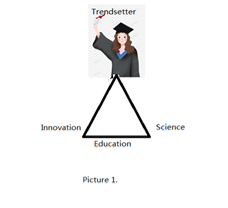
The design of the model reflects an assertion that each component is absolutely essential and one missing element will considerably reduce a graduate’s employability. A degree of overlap between some of the components is acknowledged and this is reflected in the visual presentation of the model. [7] However, it is not suggested that these are the only areas of overlap, as this occurs at various points. For example, in addition to work experience being a valuable part of career development learning, it may in some cases directly inform subject learning relevant to the degree course being studied.
Conclusion
This article has introduced the model of graduate of university, explained its components, justified their inclusion and discussed the value of the trendsetter model. Employability is a lifelong issue and nobody is ever perfectly employable. There will always be aspects of a person’s employability that would benefit from improvement. The model does not depict a process that a student embarks upon during their time in higher education and then graduates with employability for life. The issues within the model are likely to be revisited many times to ensure adaptability to the demands of a changing world and a better chance of occupational satisfaction and success.
Providing students with the opportunities to gain the necessary skills, knowledge, understanding and personal attributes through employability related activities is obviously of great importance. However, without opportunities to reflect on these activities and evaluate them, it is unlikely that this experience will transfer into learning. This type of reflective learning often takes the form of written learning logs or reflective journals but could also include audio, video and e-portfolios. Reflection can help a student to gain employment by providing a means by which they can become aware of and articulate their abilities. But additionally it is an ability that will help them in their employment and as a contributor to lifelong learning skills; It is also through the process of reflection and evaluation that our students are able to develop their self-efficacy, self-confidence and self-esteem — crucial links to employability.
References:
- Foster, [Reflection of Careers Adviser], The Journal of Association of Graduation, 2006
- Hillage J., Pollard, [Department for Education and Employment], Research Brief 2007, p.21
- State Program of the Republic of Kazakhstan — The Development of Science and Technology for 2013- 2020 years, [Kazakh Education Journal] 2019, p.7
- Toffler, [Creating a new civilization], Turner Publishing, 1995
- Drucker, [Innovation and Entrepreneurship], New York, 2017
- Sieger P., [Entrepreneurial intentions and activities], University of St.Gallen, 2000
- Van Vaugh, [The EU innovation Agenda], 2009