Introduction
Modern higher education faces a profound transformation necessitated by globalization and digitalization. In this environment, mastering a foreign language is no longer a secondary skill but a vital prerequisite for professional success, involving the ability to conduct scientific discourse, participate in international projects, and navigate intercultural interactions. Despite this, traditional university models often rely on a «banking» system—a term popularized by Paulo Freire where knowledge is passively «deposited» into students. This model frequently results in high language anxiety and a lack of spontaneous communicative ability. Higher education must instead aim to develop «adaptive, reflective practitioners» capable of lifelong learning. Open Space Technology (OST), originally conceptualized by Harrison Owen, is proposed here as an innovative tool to bridge the gap between theoretical knowledge and professional practice by fostering a non-hierarchical, self-organizing learning environment [1].
Theoretical Foundations
Transformative Learning and Disorienting Dilemmas. Rooted in the work of Jack Mezirow, Transformative Learning Theory posits that adult learning is defined by the testing of assumptions [2]. A central concept is the «disorienting dilemma»—an experience where established frames of reference no longer suffice to solve a problem. In an OST-guided course, the lack of a pre-set agenda serves as a deliberate disorienting dilemma, forcing university students to move from passive reception to critical reflection and the construction of new meaning. Communicative Action and Discourse. The theoretical merit of OST is further supported by Jürgen Habermas’s theory of Communicative Action. Habermas distinguishes between instrumental learning (technical expertise) and communicative learning (understanding others and oneself) [3]. Professional foreign language competence falls into the latter, requiring a «communicative community» where students participate in discourse based on the «force of the better argument» rather than teacher authority. OST facilitates this by providing a safe space for intersubjective recognition, which is a prerequisite for self-realization and democratic participation. Discursive Competence in Professional Contexts. Discursive competence is characterized by cohesion, coherence, and consistency in speech. In higher education, this involves the ability to form logical, complex language constructions that allow for the rational interpretation and reproduction of professional statements. OST encourages the development of this competence by placing students in authentic, unpredictable communicative situations where they must solve specific professional tasks through interaction.
The Model of Implementing Open Space in Higher Education
The proposed model for developing professional competence through OST is a multidimensional framework designed to integrate self-directed learning into the academic process.
– Target Component: The primary goal is to develop students’ readiness for professional communication by fostering academic autonomy and responsibility.
– Content Block: The content is organized around core thematic units relevant to the students' majors, such as ethical dilemmas in business, the ethics of Artificial Intelligence, or intercultural conflict resolution. This block provides the lexical-grammatical support necessary for deep academic discussion.
– Organizational and Technological Block: This is the core engine of the methodology, governed by four principles and one law:
- Whoever comes are the right people: Focuses on participants who have a genuine interest in the topic.
- Whenever it starts is the right time: Encourages spontaneous creative inspiration.
- Whatever happens is the only thing that could have: Promotes focus on the present interaction.
- When it’s over, it’s over: Discourages unproductive persistence once the energy for a topic is exhausted.
– The Law of Two Feet: This central tenet grants students the freedom to move to another group if they are neither learning nor contributing, which fosters professional mobility and personal responsibility.
– Facilitation Role: The teacher transitions from a central authority to a facilitator or «gardener» who prepares the environment and «holds the space» without interjecting or controlling the content of discussions.
– Results Block: Success is measured through indicators of linguistic growth, communicative confidence, and autonomy, classified into high, medium, and low levels of competence.
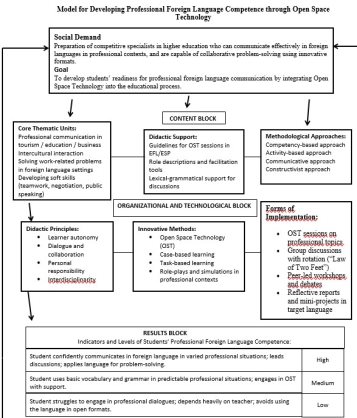
Fig. 1. Model for implementing OST
Discussion
The findings support the view that OST acts as a powerful «motivational antidote» for students who have been socialized into passive learning roles. By removing the «banking» model, OST activates communicative action—a discourse where the only force is the «force of the better argument». The model aligns with Self-Determination Theory (SDT), which posits that motivation is highest when students feel a balance of autonomy, competence, and relatedness [4]. The «Law of Two Feet» mimics the fluid nature of modern global industries, where professionals must act as «bumblebees» (pollinating groups with ideas) or «butterflies» (creating an atmosphere for unexpected connections). Furthermore, the transition to OST highlights the importance of the facilitator’s disciplinary depth; the educator must be an expert resource who is accessed by students on demand, rather than a lecturer who imposes a fixed agenda. While traditional methods may suffice for basic linguistic drills, OST is superior for providing transformative experiences where students move from «receiving» knowledge to «constructing» it in a social, intersubjective context [5].
Conclusion
Open Space Technology provides a robust, scientifically grounded framework for developing professional foreign language competence in higher education. By transforming the classroom into a democratic community of practice, the model allows students to develop not only language skills but also the self-directed learning habits necessary for lifelong professional success. Future implementation should focus on comprehensive facilitator training for university educators to ensure they can effectively manage the «Open Space» without regressing into traditional control-based instruction.
References:
- Owen, H. (2008). Open Space Technology: A User's Guide.
- Mezirow, J. (1991). Transformative Dimensions of Adult Learning.
- Habermas, J. (1987). The Theory of Communicative Action.
- Patton, M. Q. (2019). Professional Development in Uncertain Times.
- Knowles, M. S. (1975). Self-Directed Learning: A Guide for Learners and Teachers.