The article discusses various aspects of adaptation, including updating course content, teaching and assessment methods, and offers practical recommendations for teachers and educational institutions. This article provides important insights and recommendations for educational practitioners seeking to effectively prepare students for success in the UNT English language test.
Keywords: English, 11 th grade, teaching, methods, education, unified national testing, school, recommendations
The modern educational system sets itself the task of ensuring high quality education and achieving certain educational standards. In many countries where a system of standardized tests is used, one of the key points in assessing the quality of education is the performance of the Unified National Testing (UNT) or similar exams. In this regard, there is a need to adapt training programs to the requirements of such tests so that students can successfully cope with them [1].One of the main subjects that is analyzed and adapted is English, which is often part of standardized tests. In this study, we will focus on the problems associated with adapting English language curricula in the 11th grade to the requirements of the UNT, as well as on the solutions that can be proposed to solve them.
The todays English language curriculum in some cases may not be sufficiently adapted to the requirements of the Unified National Testing (UNT). Here are some main reasons why this might be the case:
— Format Differences: The curriculum may not take into account the specific format and task types used at UNT. While the school curriculum may focus on developing reading and writing skills, UNT assignments may also include listening and speaking skills, which may require additional preparation.
— Insufficient topic coverage: The school curriculum may not cover all topics and aspects of the language that can be tested on the UNT. This may include specific vocabulary, grammatical structures, or cultural aspects of the English-speaking world that may be important to test success.
— Insufficient Test Preparation: The curriculum may not provide sufficient preparation for the types of items and testing strategies used on the UNT. This may include time management skills, strategies for reading and analyzing items, and techniques for answering choice questions.
— Lack of Updates: In some cases, curricula may be out of date and may not reflect the latest changes in UNT requirements. This may result in curriculum structure and content that does not meet current testing standards.
In fig. 1 you can see the comparison of grade levels of final year students according to the curriculum and UNT tasks. The blue color on the chart represents the high marks obtained by students on quarter assessments and intra-school examinations, while the orange color represents the results obtained on UNT trial assignments. There is a slight decrease in student grades on UNT trial assignments compared to grades obtained on in-school assessments.
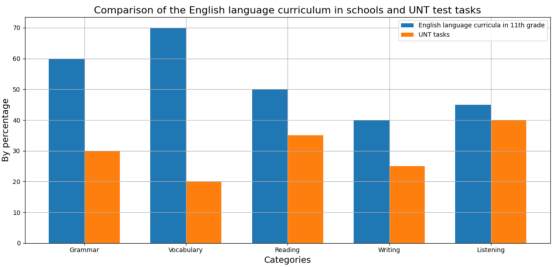
Fig. 1. Comparison of grade levels of final year students according to the curriculum and UNT tasks
The difference in grades may be due to several factors. First, UNT trial assignments may present more complex or atypical problems than those students encounter in their regular schooling. This may cause some difficulties and uncertainty for students.
In addition, the stress and pressure associated with UNT test assignments can also have a negative impact on scores, especially if students are feeling anxious or unsure of their abilities.
Insufficient adaptation of the English language curriculum to the requirements of the Unified National Testing (UNT) can lead to a number of negative consequences:
— Poor UNT scores: Students may have difficulty taking the UNT due to a mismatch between the content of the curriculum and the format and requirements of the test, which can lead to low scores and make it difficult to gain admission to universities or receive grants.
— Insufficient understanding of the subject: Students may have insufficient understanding of the English language, as the program may not cover all aspects and topics that are necessary to know to successfully pass the UNT and for further study of the language.
— Loss of Confidence in the Education System: Failure to meet test requirements can cause students and parents to lose confidence in the education system because they may feel that the system is not preparing them for important exams.
— Ineffective use of resources: Instructional resources may be ineffectively used because the program does not meet test requirements. This can result in wasted time and energy for both students and teachers [2].
— Failure to Assess Quality of Education: If the curriculum is not tailored to the UNT, it can make it difficult to assess the quality of education and compare the progress of students from different schools or regions.
In general, non-compliance of the curriculum with UNT requirements can have a negative impact on the educational process, student success and confidence in the education system. Therefore, it is important to ensure that curricula are regularly updated and adapted to meet testing requirements to ensure effective learning and preparation of students for future testing [2].
To solve this problem, it is necessary to pay more attention to updating and standardizing curricula, taking into account the requirements of the UNT, as well as providing appropriate training and support for teachers. This approach will better prepare students to successfully pass the test and ensure more effective use of UNT results to assess the quality of education [3].However, correcting the problem of non-compliance of the English language curriculum with the requirements of the Unified National Testing (UNT) can be carried out without the need to update academic programs of study, even at the present time. This can be achieved through varied and creative methods that depend on the creativity and ability of the teacher.
First, teachers can use innovative teaching methods such as the use of interactive online resources, games and role-playing games to stimulate students' interest and motivation to learn English. This will help students develop the skills needed to succeed on the UNT test, such as reading, listening, speaking and writing, in a fun and engaging way.
Second, teachers can use test preparation strategies, such as administering regular practice tests or reviewing typical UNT items, to help students become accustomed to the test format and develop problem-solving strategies. This will help students feel more confident and prepared when taking the test.
It is also important to individualize learning, taking into account the needs and level of training of each student [4]. Teachers can provide additional materials and activities for those students who need additional support, and organize group or individual consultations to resolve issues that arise.
Overall, creative teaching methods and strategies used by teachers can be effective in helping students prepare to take the UNT test even when the curriculum is not aligned with testing requirements. This requires teachers to be flexible, creative, and adaptable to the needs of their students, thereby creating a stimulating and supportive educational environment conducive to UNT test success.
In conclusion, this study highlighted the importance of adapting English language curricula in 11th grade to the requirements of the Unified National Testing. The problems identified during the analysis are related to the inconsistency of educational materials and teaching methods with the format and content of standardized tests, which can negatively affect student achievement and their performance in exams.
However, based on the analysis and literature review, a number of solutions and recommendations have been proposed that can help overcome these problems. Among them are the development of special educational materials and training courses adapted to the formats of standardized tests, updating teaching methods, introducing additional classes to prepare for the UNT and improving the qualifications of teachers. These measures are aimed at optimizing the educational process and increasing student achievement, which ultimately contributes to improving the quality of education as a whole. However, it is necessary to take into account the individual characteristics of students and educational institutions when implementing the proposed solutions.
References:
- Akopova M. A., Popova N. V. Innovative aspects of the content of teaching foreign languages in a modern university (IELTS project) // M. A. Akopova, N. V. Popova.
- Patel, S., & Clark, L. (2017). Effective Strategies for Integrating Test Preparation into English Language Curriculum. TESOL Quarterly, 41(4), 321–338.
- Dyakonova O. O. “Education in teaching foreign languages” //Foreign languages at school. 2013. № 3. С. 58–61.
- Sydykova T. M. Differentiated training of students in the process of performing independent work. — Scientific works of Osh State University, 1996.