The article is devoted to examine epithet from the position of cognitive linguistics. In this respect, epithet is presented as a cognitive structure which can be studied from the perspective of knowledge structures and conceptual blending. Special attention in the article is paid to the principle of conceptual blending according to which epithet is presented as a complex cognitive structure containing of four mental spaces. Epithet «burning humiliation» is analyzed for the purpose of illustration of the mechanism of conceptual blending in a stylistic device. The method of cognitive mapping is applied in the process of analysis.
Key words: epithet, conceptual blending, method of cognitive mapping.
Epithet is the most widely used stylistic device which makes speech expressive, emotive and evaluative. Traditionally, epithet is defined as “a stylistic device based on the interplay of emotive and logical meaning in an attributive word, phrase or even sentence used to characterize an object and pointing out to the reader some of the properties or features of the object with the aim of giving and individual perception and evaluation of these features or properties” [1]. So, traditionally epithet as other stylistic devices has been studied from the position of its structural and semantic organization and stylistic functions.
From the semantic position, epithets are divided into associated and unassociated, transferred and figurative. Associated epithets are those which immediately refer the mind to the concept due to some quality of the object it is associated to. For instance: careful attention, fantastic terrors. On the contrary, unassociated epithets are attributes used to characterize the object by adding quite unexpected feature. For instance: heart- burning smile, bootless cries, voiceless sands and so on. Transferred or figurative epithet is an attribute describing the state of a human being, but made to refer to an inanimate object. For instance: sleepless pillow, merry hours, a disapproving finger and so on. In other words, transferred epithets are epithets formed of metaphors, metonymies, similes expressed by adjectives.
Structurally, epithets can be viewed from the point of their composition and distribution. Compositionally, epithets are divided into: simple, compound, phrase and sentence. Simple epithets are ordinary adjectives: rosy dreams, sweet perfume. Compound epithets are epithets build like compounds: curly- headed boy, blue-eyed girl. Phrase and sentence epithets are actually attributively used phrases and sentences. For instance: The cat had do not-you-touch-me-I-will- you expression of its face. Another structural variety of epithet is reversed epithet or inverted [1]. Reversed epithet is two nouns linked in an of-phrase. For instance: adoll of a baby, a devil of a job.
From the position of distribution of epithets in the sentence, there are: single, strings of epithets, transferred or figurative epithets. Single epithet is a simple epithet which expressed by one attributive word. Strings of epithet is the epithet which gives many-sided depictions of the object. For instance: sharp, intriguing, intelligent eyes that gave his game away.
As a result, traditional interpretation of epithet puts much emphasis on its stylistic functions rather than its cognitive operations involved in its meaning construction. So, a satisfactory account of this phenomenon can be achieved only by means of a cognitive approach. In this sense, epithet is regarded as a means of transmitting the conceptual information of the literary text, conveying certain knowledge structures, representing the author's vision of the world. Hence, the analysis of language media shows that from the perspective of cognitive linguistics the meaning construction of epithet can be fully explained in terms of the theory of conceptual blending. To prove it we should stress that first the process of semantic interaction forming epithet consists of two conflicting conceptual domains the interaction of which leads to the emergence of new meanings.
The theory of conceptual blending known also as a conceptual integration is one of the most modern fields of American school of cognitive linguistics. Being derived from Conceptual Metaphor Theory in the sense of Lakoff and Johnson, the given theory was developed by French and American linguists, Gilles Fauconnier and Mark Turner. Conceptual blending was defined by the linguists as «a basic mental operation that leads to a new meaning, global insight and conceptual compressions useful for memory and manipulation of rangs of meanings» [2].
According to the theory of Fauconnier and Turner [3], conceptual blending is based on four mental spaces which are considered to be small conceptual elements which are interconnected and used for local understanding and action. They are the following: generic space; input space 1; input space 2; blended space or blend.
The generic space is something that two input spaces have in common at any moment in the development of the conceptual blending. Input spaces, in their turn, refer to different domains known as source domain and target domain which have various meanings but being connected they give third new meaning named as a blend. It means that blend is the result of conceptual integration.
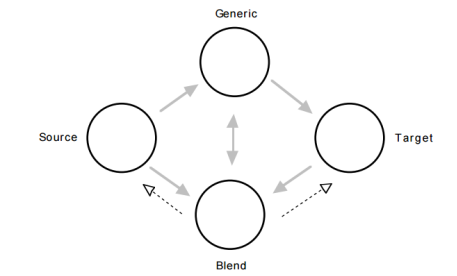
Fig. 1
The relation between these mental spaces is called mapping that can be based on analogy, similarity, recursion, mental modeling, conceptual framing, metaphor, categorization, inferences and so on [4]. To illustrate how the mechanism of conceptual blending is represented in the given stylistic device we are going to analyze the metaphorical epithet used in the following sentence: Her panic gave place to anger and a burning humiliation. So, let us analyze the expression «burning humiliation». The given stylistic expression consists of two concepts: «burning» that is more concrete and «humiliation» that is more abstract. Thus, we can elicit two input spaces: «burning» which refers to input space I or source domain and «humiliation» which refers to input space II or target domain.
The approach we apply in the analysis is cognitive mapping that consists of several stages. Initially, it is necessary to define dictionary meanings of both concepts. Afterward, it is essential to set all appropriate associations concerning the analyzed notions with the help of the literary text and dictionaries. The given steps will help us reveal the conceptual features of the concepts and define their common features which are regarded as the generic space in the theory of conceptual blending. Then it is possible to define the blend when combining two mental spaces by observing how features of one concept are projected onto another. For this purpose, below we present dictionary definitions of the notions «burning» and «humiliation».
Burning:
- Hot, flaming, extreme interest or importance (C. E. D).
- Being on fire, affecting with heat (C. E. D).
- A fundamental importance resembling that produced by a burn (M-W. E. D).
- Very hot or bright (O. E. D).
- Very keenly or deeply felt, intensive (Col.E.D).
- Of urgent interest or importance, exciting or calling for debate (Col.E.D).
- Very important or urgent question (Col.E.D).
- Feeling very strongly about (Col.E.D).
According to the dictionary definitions, the following conceptual features of the concept «burning» can be outlined: bright, hot, heat, burn, flaming, extreme, affecting, importance, interest, deeply, felt, intensive, urgent, exciting, calling, feeling, strongly. As we see, the notion of burning is associated not only with fire but also includes some features peculiar to the human feelings and emotions: extreme, interest, felt, feeling, intensive, urgent, exciting, strongly.
Likewise, let us present the dictionary meanings of the notion «humiliation»:
Humiliation:
- To make you feel ashamed or lose respect for yourself (C. E. D).
- To reduce to a low position (M-W. E. D).
- To make ashamed or embarrassed (M-W. E. D).
- Embarrassment or shame you feel when someone makes your appear stupid or when you make a mistake in public (Col.E.D).
- The action of humiliating someone or the state of being humiliated (O. E. D).
According to the dictionary definitions, the following conceptual features of the concept «humiliation» can be outlined: feel, low, ashamed, embarrassed, stupid, mistake. As we see, the notion of humiliation is characterized only by negative features.
The next step of our analysis is to reveal associative links between two domains. For this purpose we refer to associative dictionaries. Initially, we present associations of the domain burning: fire, flame, heating, angry, hurtful, terrible, uncomfortable, unpleasant, uncontrolled, explosive, intolerable, powerless, agonizing, painful, suffering, unbearable. As we see the associative dictionaries present only negative features.Below with the purpose of more clear and deep explanation we present the scheme of conceptual blending mechanism in the metaphorical epithet «burning humiliation».
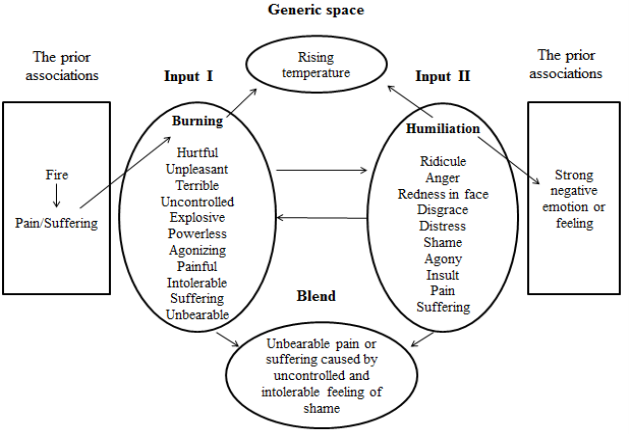
So, naturally, the generic space represents abstract commonalities between inputs that is «rising temperature». The cross-space mapping between these inputs leads to the emergent structure completed by the encyclopedic knowledge that is unbearable pain or suffering caused by uncontrolled and intolerable feeling of shame. The features of both inputs which made the basis of a new blend are as follows: feeling, shame, painful, suffering, uncontrolled, intolerable and unbearable.
To conclude, we should stress that the analysis of epithet from the position of cognitive linguistics proves: a) epithet alongside metaphor is based on the mechanism of conceptual blending; b) conceptual blending helps reveal the conceptual structure of epithet penetrating into its deep semantics.
References:
- Galperin,I. R. Stylistics [Text] /I. R. Galperin. Moscow: Higher school, 1981.- 32 p.
- Fauconnier, G. Mental spaces [Text] / G.Fauconnier. — New York: Cambridge University Press,1985.- 85p.
- Fauconnier,G. Conceptual integration networks [Text] / G. Fauconnier, M.Turner. — New York: Cognitive Science,1998.- 29p.
- Fauconnier,G. The Way We Think [Text] / G. Fauconnier, M.Turner. — New York: Basic Books, 2002.- 15p.