In modern educational institutions, much attention is paid to computer support of professional activities. The educational process uses training and testing programs in various disciplines of the educational process. This article was written about the creation of an electronic bank through the same research object, providing information about based on the cadastre of animals of the Trans-Ili Alatau (Heteroptera, Pentatomorpha).
Keywords : cadastre, electronic bank, Heteroptera, Pentatomorpha.
Statistical studies conducted at the technical school on the use of training and testing programs in various disciplines (within the framework of the educational process and computer courses) show that their use has allowed to increase not only interest in the future specialty, but also academic performance in this discipline. Most students perceive information visually better, especially if it is qualitatively framed. These programs enable each student, regardless of the level of training, to actively participate in the educational process, to individualize their learning process, to exercise self-control. Be not a passive observer, but actively gain knowledge and evaluate your capabilities. Students begin to enjoy the learning process itself, regardless of external motivational factors. This is also facilitated by the fact that with information technology training, individual functions of the teacher are temporarily transferred to the computer. And a computer can act as a patient teacher-turnip.
A short date about research object. Being represented by very diverse insects, this order is characterized mainly by a piercing-sucking oral apparatus forming a proboscis, gradual transformation and the presence of wings in most cases. With rare exceptions, these insects have large compound eyes, antennae containing from 4 to 10 segments, and the segments themselves are often long, and two pairs of wings with relatively simple and reduced venation; there are no cerci on the abdomen. In many families, females have well-developed scabbards on their abdomen and a saw-shaped ovipositor of this type. The name of the order — «half—wings» — is explained by the peculiarity of the structure of the front wings in many families: the basal part of the wing, or corium, is rigid and thickened, and the apex (membrane) is thin and transparent. The exception is the third group, which contains only a single circum-Atlantic genus Peloridium with a torn area and is represented by small forms that occur on the bark of Notophagus. In many respects, the genus Peloridium occupies an intermediate position between Homoptera and Heteroptera, it lacks a throat, which is characteristic of Homoptera, and its other features correspond to Heteroptera. Some authors place this genus as an aberrant group in the family Peloridiidae, others consider it as part of a special suborder — Coleorhyncha [1]. The four remaining large groups have so many different ancestral traits in common with each other that their relationship to each other is obvious, but it is still unknown exactly how these groups correlate in phylogeny and whether each of them has a monophyletic origin. Cimicomorpha is a rich group of terrestrial and ectoparasitic forms with strongly reduced venation of the anterior pair of wings. Leptopodomorpha are inhabitants of the coasts with a very characteristic venation at the base of the wing (Fig. 1). The Reduviidae and related families with massive mouths of the dorsal odorous glands of the abdomen may belong to this group.
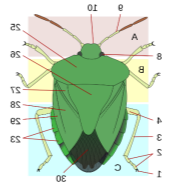
Fig. 1. Anatomy of the dorsal aspect of a shield bug. A: head; B: thorax; C: abdomen. 1: claws; 2: tarsus; 3: tibia; 4: femur; 8: compound eye; 9: antenna; 10: clypeus; 23: laterotergites (connexivum); 25: pronotum; 26: scutellum; 27: clavus; 28: corium; 29: embolium; 30: hemelytral membrane
Methodological materials are placed in the electronic bank by specialists of structural divisions based on the results of their expertise and the availability of an expert opinion on the introduction of methodological materials into the electronic bank. The purpose of the bank's formation is to identify, study and disseminate the best pedagogical practices, educational programs, including programs of additional professional education. the information about the electronic bank is the basis for the organization of joint work of the institute's employees with employees of methodological services, centers, educational organizations. these materials are placed in the electronic bank by specialists of structural divisions based on the results of their expertise and the availability of an expert opinion on the introduction of methodological materials into the electronic bank [2]. The placement of materials in the bank is carried out taking into account the List of methodological materials placed in the electronic bank, the availability of a description of advanced pedagogical practice or other methodological materials (text format), video clips about work experience, presentations, applications and expert opinion of employees of the structural unit of the in the article on the possibility of including methodological materials in the bank, the written consent of the author of methodological materials for their distribution, including the gratuitous publication of materials in the publications of the regional information center of the Institute [3]. Methodological materials, after their consideration in the structural subdivision of the Institute, are sent to the organizational and methodological department marked «Recommended for publication in the electronic bank of the Institute» and then transferred to the information technology department or to the library of the Institute for publication on the Institute's website or storage in paper or electronic form. The authors of the methodological materials can be pedagogical and senior officials of the education system, educational organizations and teaching teams, specialists of the Institute and other organizations of additional professional education.
Directions of work with methodological materials of the electronic bank
Methodological materials of the electronic bank of the Institute can be used:
— when implementing educational programs using remote educational technologies,
— when implementing educational programs in full or partially in the form of an internship,
— when organizing the practical part of the training courses in full-time (workshops, round tables, seminars, trainings and other forms of practical work),
— when organizing network interaction of educational and other organizations,
— when drawing up individual educational trajectories of teaching staff,
— in preparation for participation in interregional, regional and municipal competitions [4].
Database of Heteroptera,Pentatomorpha. Via below the specified datebase we can form of an educational and methodological system of an electronic bank (table 1).
Table 1
|
collection |
Affiliation to the organization |
Storage form |
Genus |
Species |
Sex |
Quantity |
A country |
Region |
Collector |
|
Entomological |
Zoology Institute |
dry |
Dicranocephalus |
Dicranocephalus agilis (Scopoli, 1763) |
♂ ♀ |
54 |
Kazakhstan |
South Kazakhstan |
Esenbekova,Baibol |
|
Entomological |
Zoology Institute |
dry |
Dicranocephalus |
Dicranocephalus agilis (Scopoli, 1763) |
♂ ♀ |
23 |
Kazakhstan |
West Kazakhstan |
Esenbekova,Baibol |
|
Entomological |
Zoology Institute |
dry |
Dicranocephalus |
Dicranocephalus agilis (Scopoli, 1763) |
♂ ♀ |
12 |
Kazakhstan |
West Kazakhstan |
Esenbekova,Baibol |
|
Entomological |
Zoology Institute |
dry |
Dicranocephalus |
Dicranocephalus agilis (Scopoli, 1763) |
♂ ♀ |
12 |
Kazakhstan |
North Kazakhstan |
Esenbekova,Baibol |
|
Entomological |
Zoology Institute |
dry |
Rhynocoris |
Rhynocoris annulatus (Linnaeus, 1758) |
♂ ♀ |
3 |
Kazakhstan |
West Kazakhstan |
Esenbekova,Baibol |
|
Entomological |
Zoology Institute |
dry |
Rhynocoris |
Rhynocoris annulatus (Linnaeus, 1758) |
♂ ♀ |
45 |
Kazakhstan |
North Kazakhstan |
Esenbekova,Baibol |
|
Entomological |
Zoology Institute |
dry |
Rhynocoris |
Rhynocoris annulatus (Linnaeus, 1758) |
♂ ♀ |
34 |
Kazakhstan |
West Kazakhstan |
Esenbekova,Baibol |
|
Entomological |
Zoology Institute |
dry |
Coranus |
Coranus subapterus (De Geer, 1773) |
♂ ♀ |
12 |
Kazakhstan |
North Kazakhstan |
Esenbekova,Baibol |
|
Entomological |
Zoology Institute |
dry |
Lygaeus |
Lygaeus equestris (Linnaeus, 1758) |
♂ ♀ |
11 |
Kazakhstan |
North Kazakhstan |
Esenbekova,Baibol |
|
Entomological |
Zoology Institute |
dry |
Lygaeus |
Lygaeus equestris (Linnaeus, 1758) |
♂ ♀ |
14 |
Kazakhstan |
North Kazakhstan |
Esenbekova,Baibol |
|
Entomological |
Zoology Institute |
dry |
Rhyparochromus |
Rhyparochromus vulgaris (Schilling, 1829) |
♂ ♀ |
5 |
Kazakhstan |
South Kazakhstan |
Esenbekova,Baibol |
|
Entomological |
Zoology Institute |
dry |
Aphanus |
Aphanus rolandri (Linnaeus, 1759 ) |
♂ ♀ |
6 |
Kazakhstan |
South Kazakhstan |
Esenbekova,Baibol |
Conclusion. «Without striving for the new, there is no life, no development, no progress». These words were said a long time ago. Then no one even thought about computer technology. But, it seems to me, these words are about him, about a modern teacher, about a teacher who strives forward, who is ready to master everything new, innovative and successfully apply in the practice of his work. Thus, it can be concluded that the introduction of an e-learning system into the educational process undoubtedly contributes to:
— improving the quality of knowledge, skills and abilities acquired by students;
— to increase the level of professional motivation and competence of teachers, their information culture;
— development of the information and educational space of the technical school and strengthening of the material and technical base. Conclusion — it is necessary not to stand still, but to improve our techniques and methods and then we will achieve success in our professional activities.
References:
- Tree of Life Web Project (2005): Heteroptera. True bugs. Version of January 1, 2005. Retrieved July 28, 2008.p.67–68
- The use of electronic educational resources of a new generation in the educational process: Scientific and methodological materials / Bordovsky G. A., Gotskaya I. B., Ilyina S. P., Snegurova V. I. — St. Petersburg: Publishing House of the A. I. Herzen State Pedagogical University, 2007. — p.31–37
- Polhemus, John T.; Polhemus, Dan A. (2008). «Global diversity of true bugs (Heteroptera; Insecta) in freshwater». Hydrobiologia. 595 (5): 379–91. doi:10.1007/s10750–007–9033–1. S2CID 45657091, p.78–80
- Sorensen, J. T., B. C. Campbell, R. J. Gill & J. D. Steffen-Campbell (1995): Non-monophyly of Auchenorrhyncha («Homoptera»), based upon 18S rDNA phylogeny: eco-evolutionary and cladistic implications with pre-Heteropteroidea Hemiptera (s.l.) and a proposal for new monophyletic suborders. Pan-Pacific Entomologist 71 (1): p. 45–47.