This article deals with the application of new technologies in physical training of higher educational institutions. Also there were studied the Implementation of cluster-modular method in groups of students with different levels of physical fitness.
The relevance, timeliness, or even evidence of the need for co-temporal clustering process today does not almost cause the doubt. Curiously, the actual scientific approach to clustering today is relatively little developed and relatively reflected in the scientific literature; in addition to this, the term «cluster» has firmly entered the cage is not too clear, but obviously fashionable notions that, «clogging» the categorical scientific apparatus, often do not carry any meaning, nor, especially, practical significance. Meanwhile, the clustering phenomenon was studied, — though almost exclusively in the natural sciences — long before he became so fashionable.
The etymology of the concept of cluster (from English Cluster, in details — «beam, swarm, bush») — very controversial: a term borrowed from the sciences, not having purely economic nature, now easy to «take root» in the humanitarian fields of scientific knowledge. Now the term is widely used in computer science and programming, mathematics, physics, chemistry, economics, sociology, etc. Let’s note, that, however, neither edition, nor even common understanding of how clustering and cluster formation processes of social clusters in modern science, unfortunately, did not happen. [3, 2.1].
Let’s distinguish the given the scope of the article, the main characteristics, sociological and semantic indicators of accepted cluster model.
The cluster cannot serve as a symbol that does not exist in the system, including the social, nor, moreover, the designation of a single event or phenomenon. In this case, taking into consideration the classical dialectic models of Aristotle, V. Leibnitz, G. Hegel, Kant, thinkers of the Vienna School and the positivist tradition in general, the concept of a cluster would simply hut-accurate with respect to the well-established system of categories and the element; single, particular and general; norms and deviations, social dissipation, etc.
The concept of a cluster, according to the ideas of authors, describes specific condition of social community, including description of not only of this community, but also the process of its formation, structuring and its interaction with social environment.
The peculiarity of using information technologies in physical education and sports means the organization of management of biological objects that formalizes with difficulties. From this point of view, there are discussed questions regarding to objective-subjective relations between teachers and students taking into consideration their biological features. Thus, we can select affordable and informative indicators of physical conditions for practical use in physical education that can be measured and evaluated. They can be: somatic-metric, somatic-scoped and physical-metric performance, physical fitness, physical activity, the incidence. When selecting measured symptoms of physical condition must be taken into account the ease of measurement, methods of evaluation and motivation of students.
Cluster analysis — is a set of methods that allow classifying multi-dimensional observation, each of which describes a set of variables of specific variables. The goal of cluster analysis is the formation of groups of similar objects with each other, which are called clusters. [2].
Nowadays, researchers have so many software packages in the arsenal that allow optimizing and simplifying the analysis procedure. The most widely used packages are such as Vortex, SPSS, Statistica. The software «VORTEX» is designed for: inputting of primary information.
Opportunities of data analyze:
The software Vortex allows conducting descriptive statistics of studied variables (calculation of statistics: mean, mode, median, quartiles, dispersion, mid-quadratic deviation, coefficient of variation, excess etc.);
It allows conducting segmentation on multiple grounds, as well as the selected target groups (emphasis contexts — sub massive documents for in-depth analysis, for example, only men or only to respondents of 20–25 aged people).
Using a cluster-modular method for the development of individual recovery programs, the correct evaluation of the functional and physical condition is of great importance, as it allows not only studying the influence of physical exercises on body, but sometimes helping to diagnose latent disease, to establish adaptability to physical exercise, determining its optimality etc.
The module can be presented as a training element in the form of standard booklet that consists of the following components: Precisely formulated learning goal;
A list of necessary materials equipment; A list of related educational elements; Proper training material in the shape of a summary of a particular text, following by detailed illustrations; Practical exercises to practice action skills;
At present, an urgent need to develop scientific bases of systematization and analyzing new educational technologies in physical education that can solve variety of tasks: transferring the knowledge, control the course of assimilation, demonstration of illustrative materials and development of physical fitness.
E. B. Solovyova (1996) considers that the major problem of organization of the process of physical education is searching for education system, which allows monitoring the educational activity process the degree of assimilation loads of students that were obtained during the lesson that enables to individualize physical development of the individual. [4].
It is important to know own body, learn how to encourage own actions, be able to remove nervous and muscular tension and psycho-emotional exhaustion. This is confirmed by various researches that are statistically proven decreasing morbidity among students, whereas increasing physical and intellectual capacity of capability of those who deliberately (in the period of all 4–5 years of education) used the system of rehabilitation measures.
Modeling serves as a method of «indirect practical or theoretical operating entity in which we investigate not directly the object we are interested at, but used an auxiliary artificial or natural system («Quasi-object»), located in the certain objective according to the known object that can replace it at certain stages of learning and providing when researching ultimately, information about the modeled object.”
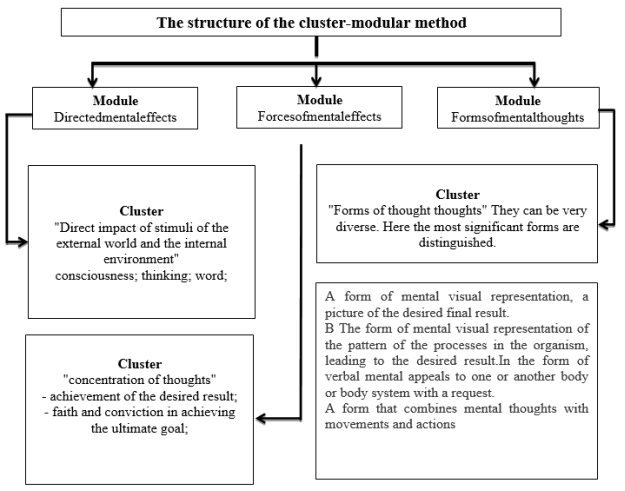
Fig. 1. The structure of the cluster-module method. (Y,S Vainbaum)
The activities of the teacher should be considered not only as giving each student structured, focused and motivated information on conceptual and methodological content, methods of work in the areas of knowledge from different sectors of physical education, but also as direct and indirect control of the teacher their physical activity on achieving skills and abilities in accordance with the intended learning objectives.
The usage of computers in medicine and physical education provides great opportunity. To summarize, it is necessary to note that individualization of physical education classes means developing the dynamic monitoring observation (monitoring) for physical education and student’s health condition.
It is possible to carry out with the help of modern information technologies by using cluster-modular educational method which in physical training the students with weakened health practically do not use, all of the above points to the need, searching for new forms of assessment of knowledge quality and skills for students, having serious disturbances in health.
However, despite the high potential modern information technologies, they have not found more widespread usage in the higher physical education system. In view of the above, introduction of modern information technologies in educational process on physical training of students with different levels of physical fitness, today is very important.
Cluster-module method is considered to be a new trend in the modern method of coordination abilities, and endurance of other physical and psycho acting abilities of students with different levels, in general the problems targeting their development.
References:
- Classification and cluster / under edition of J. Van Raisin// Trans. from English. P. P. Kolsova; under edition of Y. I. Juravleva.-- Moscow: Mir, 1980- p.388.
- M. S Oldenderfer, R. K Bleshfild Cluster analysis / In the book: Factorial, discriminated and cluster analysis. — Moscow: Finance and statistics, 1989, p.215.
- M. Jamba, Hierarchical cluster analysis and conformity // Trans. from French by B.G Mirkina — Moscow: Finance and Statistics, 1988. — p. 300.
- M.V Prokhorov, A.A Sidorov, B.D Sinyuhin, A.G Semenov Pedagogic of Physical Culture: Textbook Moscow: Publishing house “Put”: TTI «Alliance», 2006. — p. 129.