As we begin our discussion of multimodality, it is worth saying that the very term ‘multimodal’ can be explained as ‘ designed complex of different modes or sign-complex’ [2]. The term ‘multimodality’, in its turn, consists of two parts -‘multi’ and ‘modality’, which carry a certain meaning. Thus, if modality can be defined as ‘a means for making meaning’ [3], then we can assert that multimodality is ‘a recognition of the fact that people use multiple means of meaning making’ [3].
Speaking about historical framework, we may say that the emergence of the notion of multimodality is closely related to the beginning of the 21 st century, when various advanced technologies and new media began to appear. Moreover, multimodality has managed to penetrate diversified fields of science: philosophy, psychology, medicine, logistics and many others.
In the present research, we are particularly interested in the interrelation of multimodality and linguistics. We are used to considering linguistics only from the point of view of its verbal components, forgetting the fact that sometimes some multimodal elements come to our rescue when trying to better understand the word's meaning.
Multimodality is inextricably linked to the concept of ‘intersemiotic translation’. This term was introduced to linguistics by R. O. Jakobson and can be defined as ‘an interpretation of verbal signs by means of signs of nonverbal sign systems’ [4]. It means that we may interpret the verbal content with the help of other semiotic systems, mostly non-verbal ones. Among them are: music, painting, cinema, etc. We may say that the use of multimodality helps to support an idea that was implied by a film director, an artist or even a stand-up comedian.
Although semiotic resources are different in terms of possibilities they offer for ‘making meaning’, it does not follow that some of them are more or less potential, because it is not their ‘power’ in isolation that matters, but an entire multidimensional ‘image’ they can create together. Moreover, multimodality disproves the traditional opposition of verbal and non-verbal formats, showing that we can no longer treat verbal communication as primary in comparison with non-verbal one. In other words, multimodality questions the idea that ‘language is the single most powerful mode of communication’ [3].
Let us now proceed with the main subject of the present investigation, the genre of stand-up comedy, and analyze the role multimodality plays in it. It this connection, it is of great importance to mention a number of communication channels:
– Verbal (segmental)
– Prosodic
– Visual
– Kinetic
These three communication channels are interdependent and interrelated; information is distributed between them in a complex way. In the practice of mainstream linguistics, the verbal channel is prioritized; other channels are taken into account as auxiliary. However, speaking about the stand-up comedy genre, we are going to pay special attention to the visual communication channel. This communication channel includes ‘gestures, gaze direction, facial expressions, postures, proxemics, cultural symbolism and, in general, ‘body language’’ [1]. Stand-up comedians turn to the use of body language and facial expressions all over the place during their performances, because these are the instruments, which help them highlight a certain emotion and more accurately convey it to the audience. Moreover, in some cases, gestures and facial expressions visually supplement the information that was given verbally.
Thus, for example, Cristela Alonzo in her performance ‘Being 40 is like being an iPhone 6’ described the following situation:
‘It's weird, because I've noticed things haven't changed, but they have so in subtle ways, you know, like all of a sudden now I want to be thanked when I do nice things for people and I get very pissed off, when I don't get a thank you. Example: if we're in traffic and I let you into my lane and you don't give me one of these [Cristela makes a special gesture with her hand] ’.
While telling the story, the comedian made the following parallel gesture. Let us illustrate it on picture 1.
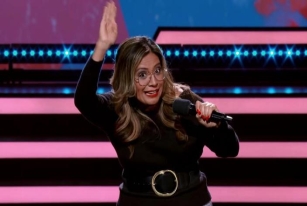
Fig. 1. C. Alonzo making a special gesture for drivers
This mode did not only allow the audience to visualize the situation much more vividly, but also made this piece of the story more humorous.
However, it is of great importance to remember that stand-up comedy is quite a ‘free’ genre, therefore, every comedian decides whether to use body language or limit himself or herself only to words and intonation. Whatever the choice, in our opinion, a much more comic and memorable effect is achieved in those performances that abound in gestures and facial expressions. A great example of such stand-up comedy is an American comedian Tom Papa. Let us have a look at his performance that is called ‘Dads get no respect’.
In this humorous monologue, one of the topics the comedian is pondering is women and their addiction to makeup:
‘Just the makeup alone. Just this neverending art project you're involved in. Carrying luggage around your entire lives filled with art supplies: brushes and pencils and paints, just painting the same face over and over and over. And what are you doing it for, who are you doing it for, why do you do it [And then Tom Papa begins to illustrate the way women put makeup on their faces] ?’
Tom Papa ridiculed the way women apply makeup every day, wash it off in the evening, and then repeat this routine the next day for the rest of their lives. Let us illustrate it on pictures 2 and 3.
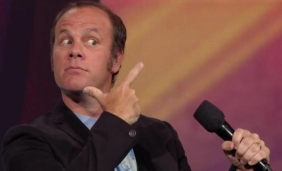
Fig. 2. T. Papa ridiculing the way women apply make-up
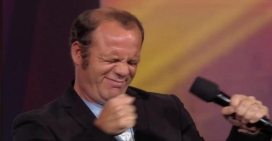
Fig. 3. T. Papa showing his dissatisfaction with the popular image of women in cosmetic advertising
Tom Papa also mocks the popular image of women’s beauty that is usually shown in cosmetics advertising:
‘The whole image of what a woman is in the culture is demented, it's demented, I don't know how you deal with it, it's something you can't be and it's something we don't want, right. Every ad for a woman she's 6’8’’emaciated with bubble lips just scowling at us through black mascara [In this moment Tom Papa imitates the woman from the commercial] . That's not a woman, that's nice on a billboard, what would you do with that, if you got it into your house?’ Let us illustrate it on picture 4.
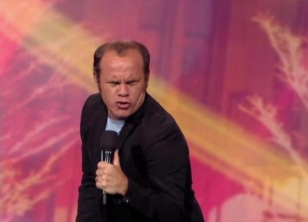
Fig. 4. T. Papa imitating the woman from the commercial
The exaggerated facial expressions and their humorous embodiment make the parody especially comic. However, the humorous effect here is also enhanced by the man’s gesture in trying to spoof a woman’s face with lots of makeup. We may assume that if Tom Papa had not decided to parody the image in this way, the audience would not have reacted so quickly and picked up on the joke.
If in the example with Cristela Alonzo, her gesture for drivers just helped the comedian to explain what she was talking about more clearly, guide the audience in visualizing the situation through its physical manifestations and increase the humorous effect that was created verbally, Tom Papa uses overstated facial expressions mostly for the purpose of provoking laughter and not to explain the concept described in monologue. Therefore, in these cases, multimodality was employed to perform different functions that help to diversify the performance.
There are also instances when stand-up comedians do not only resort to their body language and different facial expressions, but also use some props in their performances. They do it, because they want to immerse the audience as much as possible in imaginary (or sometimes real) humorous situations. At such moments, stand-up comedy performances begin to resemble a theatrical skit. We can see such an example in Sarah Millican’s stand-up comedy piece ‘An email from my school bully’. Let us illustrate it on picture 5.
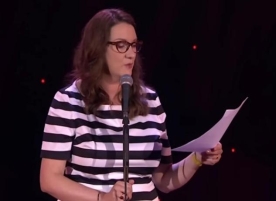
Fig. 5. S. Millican reading an email
Comedians normally tell their humorous monologues in an impromptu manner without reading from any sources. However, in this performance, Sarah Millican decided not just to retell the content of the email, but read it in front of the audience as if it were a real situation and a real email letter. Nevertheless, we should always keep in mind that in the case of the stand-up comedy genre, it is difficult to understand whether a comedian is telling a real story from his or her life experience or something fictitious. It is possible that in many instances, the basis of the story is a true event embellished with fiction in order to get a greater response from the audience.
To sum up, we have provided a concise overview of a contemporary and influential notion of multimodality. Moreover, we have illustrated with examples the realization of multimodality in the genre of stand-up comedy and have shown the possibilities that multimodality opens up for comedians in helping them to diversify their performances.
References:
- Кибрик, А. А. Мультимодальная лингвистика / А. А. Кибрик. — Текст: непосредственный // Когнитивные исследования: сборник научных трудов Том Выпуск 4. — М.: Издательство «Институт психологии РАН», 2010. — С. 135–152.
- Кресс, Г. Социальная семиотика и вызовы мультимодальности / Г. Кресс. — Текст: непосредственный // Политическая наука. — 2016. — № 3. — С. 77–100.
- Bezemer, J. Multimodality: a guide for linguists / J. Bezemer, C. Jewitt. — Текст: непосредственный // Research Methods in Linguistics. — London: Bloomsbury Academic. — С. 150–180.
- Jakobson, R. O. Linguistics and Poetics / R. O. Jakobson. — Текст: непосредственный // Style in Language. — 1960. — С. 350–377.