Introduction
Brand strategy has evolved dramatically from mere logo creation to a dynamic system that builds meaning, promises value, and creates holistic experiences (Morgan et al., 2011). In Indonesia, however, many tourism destinations remain trapped in the euphoria of visual beautification without considering the «soul» of the brand itself. This phenomenon is particularly evident in cultural tourism villages, where top-down approaches often impose external identities without engaging local narratives.
Kampung Warna-Warni (Colorful Village) in Malang City represents a compelling case study. Initially a slum area transformed through community art initiatives, the village gained viral popularity through social media. Yet beneath the surface of Instagram able photos lies a complex tension between residents' desire for comfortable daily life and pressure to maintain exotic appeal for tourists. This study addresses a fundamental question: How can art, science, and technology be integrated to develop a brand strategy that respects community identity while attracting meaningful tourism?
Results
Thematic analysis of qualitative data produced four central findings. First, art functions as both pride and point of tension . Pioneer artists view their work as collective expression, while market pressures demand continuously spectacular «photo spots» that distance creation from its organic origins. Second, residents express longing for scientific approaches to manage visitors, measure economic impact, and prioritize maintenance, yet simultaneously suspect data collection technologies as privacy threats.
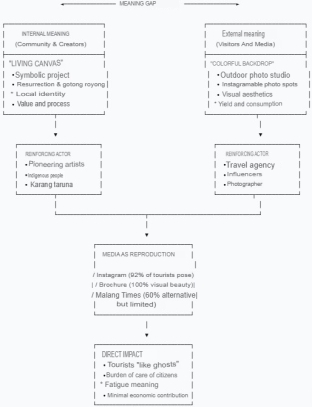
Third, technology acts as a double-edged sword . While social media enabled global recognition with minimal cost, platform algorithms reduce cultural richness to visual spectacle. One resident noted, «Tourists are like ghosts: they come, capture the light, and disappear». Fourth, a profound gap exists between internal and external brand meaning . Community members perceive their village as a «living canvas» symbolizing mutual cooperation ( gotong royong ), while visitors and media frame it as a «colorful backdrop» for photography.
Quantitative media analysis confirmed these patterns. Analysis of 20 Instagram posts revealed 92 % featured tourists posing with murals, while hashtags #instagramable appeared in 85 % of posts compared to under 5 % for #senimanlokal (local artist). Official brochures showed similar patterns: 100 % emphasized visual beauty with zero mention of artist names or creative processes. Local newspapers offered more balanced coverage (60 % addressing non-aesthetic issues), but reach remained limited to traditional readers rather than target tourist demographics.
Discussion
This study confirms that digital technology accelerates destination popularity while simultaneously reducing cultural meaning which a phenomenon consistent with Greenwood's (1989) concept of «culture by the pound». The algorithmic logic of platforms like Instagram encourages visual homogenization, creating an echo chamber where shallow narratives drown out community voices. Contrary to initial hypotheses, local mass media cannot balance this dynamic; comprehensive articles exist but fail to penetrate the digital ecosystems where travel decisions form.
The commodification of art creates genuine tension between artistic integrity and market demands. Pioneer artists report feeling distanced from their original community-art spirit as pressure mounts to produce Instagram-worthy content. This finding extends Cohen's (1988) work on authenticity in tourism by demonstrating how digital platforms intensify commodification pressures.
Most significantly, the gap between internal and external brand meaning represents a fundamental communication failure. When visitors arrive expecting only photo opportunities, they interact minimally with residents, contribute little to local economies, and may inadvertently disrespect community norms. This misalignment, reproduced through dominant media channels, threatens destination sustainability.
The longing for scientific approaches amid surveillance suspicion reveals a uniquely Indonesian paradox: communities desire data for better management but resist top-down monitoring. Participatory, transparent data systems aligned with Heeks and Shekhar's (2021) data justice framework offer potential solutions.
Conclusion
Developing a brand strategy for cultural destinations requires moving beyond visual aesthetics to integrate art, science, and technology in ways that honor community narratives. For Kampung Warna-Warni, this means building a counter-narrative that communicates «art as process» alongside «art as product», utilizing technology as a story enhancer rather than a reduction machine. Practical recommendations include QR codes linking mural artworks to artist stories, transparent digital displays of visitor contributions to maintenance, and participatory data systems that empower residents while respecting privacy. Such approaches attract not merely more visitors, but the right visitors for those who come to understand, appreciate, and contribute to the «living canvas» of community life.
References:
- Cohen, E. (1988). Authenticity and commoditization in tourism. Annals of Tourism Research, 15 (3), 371–386.
- Greenwood, D. J. (1989). Culture by the pound: An anthropological perspective on tourism as cultural commoditization. In V. Smith (Ed.), Hosts and guests: The anthropology of tourism (pp. 171–185). University of Pennsylvania Press.
- Heeks, R., & Shekhar, S. (2021). Data justice for sustainable development: A capability approach. Development Informatics Working Paper No. 80 . University of Manchester.
- Morgan, N., Pritchard, A., & Pride, R. (Eds.). (2011). Destination branding: Creating the unique destination proposition (2nd ed.). Butterworth-Heinemann.