В этой статье предлагается бережливый подход к цифровизации логистических операций малого и среднего бизнеса: ориентированная на управление архитектура WMS, которая обеспечивает отслеживаемость, стандартную работу и контроль исключений, не требуя полного внедрения WMS. Этот вклад представлен в виде научно-исследовательского набора артефактов, состоящего из: стека управления, модели данных реестра минимальных отгрузок (ERD) с протоколированием событий и индексацией документов, стандартизированных контрольных точек на всех этапах от получения до закрытия, таксономии инцидентов и детерминированных схем управления рисками, встроенных в логику запуска, 90-дневного периода и 180-дневный план внедрения, а также модель зрелости для поэтапного внедрения. Работа основана на рецензируемых исследованиях, посвященных цифровизации складов и Warehouse 4.0, принципам зрелости управления данными, ограничениям цифровой трансформации малого и среднего бизнеса, литературе по отслеживаемости и прозрачности, а также управлению устойчивостью цепочки поставок.
Ключевые слова: бережливая цифровизация, логистика для малого и среднего бизнеса, управление складом, отслеживаемость, реестр отгрузок, стандартная работа, управление данными, схемы управления рисками, устойчивость цепочки поставок, Казахстан, развивающиеся рынки.
Digital transformation in logistics is frequently articulated in terms of integrated enterprise platforms (WMS/TMS/ERP), IoT-enabled visibility, and advanced optimization. However, the pace and feasibility of such transformation are uneven across firms and geographies. International policy and research highlight the structural constraints SMEs face in digital adoption: limited financial resources, skills gaps, governance immaturity, and dependency on external ecosystem actors (customers, suppliers, intermediaries, and public institutions). In warehousing and distribution, these constraints are intensified by operational continuity requirements; SMEs cannot easily pause operations to reengineer processes around an enterprise implementation.
At the same time, traceability and documentation completeness have become operationally non-negotiable. The World Bank’s Logistics Performance Index (LPI) highlights logistics capability as multi-dimensional and increasingly connected to resilience and evidence-based measurement. The LPI 2023 report notes new “speed of trade” KPIs derived from large shipment-tracking datasets, reinforcing the global shift toward measurable logistics performance and data-driven governance.
Kazakhstan provides a salient applied context for a generalizable SME governance model. The national trade and logistics context combines large distances, regional variability, and intensifying digitization of tax and transaction controls. Official information from the State Revenue Committee (SRC/KGD) describes the Virtual Warehouse module of the electronic invoicing system (IS ESF) as a mechanism to systematize goods accounting, automate balance calculations, store electronic documents related to goods receipt/movement/write-off, and enable integration via API interfaces with ERP/accounting systems. The SRC also states that from 2019 VAT payers are required to issue invoices in electronic form via the e-invoicing information system, illustrating the institutional direction toward digital evidence.
The operational reality for many SMEs is therefore a hybrid: compliance and transaction visibility are increasingly digitalized at institutional level, while daily warehouse and transport execution may still rely on manual routines, spreadsheets, and informal coordination. This mismatch can generate failures with disproportionate cost: missing proof-of-delivery, untraceable discrepancies, delayed closure of documents that affects payments, and recurring exceptions that remain “stories” rather than analyzable signals. This manuscript addresses the following problem: How can SMEs achieve audit-ready traceability and governance discipline without deploying a full WMS?
1. SME digital transformation constraints and governance-first approaches
OECD analyses emphasize that SME digitalization is constrained by resource limitations and capability gaps; overcoming these barriers generally requires policy and ecosystem support, training, and governance maturity rather than only technology availability. The World Economic Forum similarly frames SME digitalization as a lever for resilience and supply chain performance, highlighting that frameworks should address capability building and practical adoption pathways. Peer-reviewed research reinforces the role of external actors and knowledge management in SME digital transformation, noting that customers, suppliers, intermediaries, and coopetition relationships shape adoption trajectories. These findings imply that SME logistics digitalization must be designed not only as an internal process change but as a partner-facing governance system: carrier interfaces, evidence standards, and closure rules must be operationalized.
Warehouse digitalization literature often emphasizes Industry 4.0 technologies, including scanning, IoT, automation, and real-time data. A systematic literature review on the “Intelligent Warehouse in Industry 4.0” positions digitization and real-time inventory information as critical to smart warehouse design, highlighting both technology opportunities and implementation complexity. Additional work evaluating Industry 4.0 technology adoption in warehouse management identifies barriers and benefits, reinforcing that implementation readiness and process maturity are key determinants of outcome. A practical implication for SMEs is that “Warehouse 4.0” is not an on/off switch; it is a staged journey requiring stable master data, disciplined workflows, verification routines, and governance. Without these, technology may digitize inconsistency rather than improve control. Lean-driven frameworks for warehouse optimization further support this view: systematic approaches structured around diagnostic, improvement, and control phases emphasize standardization and waste elimination as prerequisites for sustained performance improvements.
Traceability and KPI governance depend on data quality and ownership. Systematic reviews of data governance describe it as an organizational system of roles, policies, processes, standards, and technologies that govern data usage and quality, often framed through maturity models. For SME logistics, the most consequential governance domain is master data: SKU definitions, units of measure, packaging hierarchies, location identifiers, and partner codes. If these are inconsistent, the downstream costs appear as picking errors, disputed deliveries, and reconciliation failures that cannot be resolved with evidence.
2. Traceability, transparency, documentation systems, problem statement and design requirements
Supply chain transparency research conceptualizes transparency as multi-dimensional, built from information availability, accuracy, timeliness, and accessibility across stakeholders. Traceability is a more operationally specific form of transparency: it requires linking physical flows (goods) to digital evidence (events and documents). World Bank technical work on traceability systems illustrates the common event logic (e.g., shipping and receiving events between defined locations) as the minimal backbone for external traceability. This supports an event-based registry design in which each shipment has mandatory milestones that allow reconstruction. Document management systems (DMS) research indicates that organizations seek traceable approvals, version control, and auditability, and that maturity affects DMS life cycle and digital transformation readiness. Recent work on low-code/no-code document management demonstrates that traceable workflows with approval states and identity integration can be implemented in pragmatic architectures, reinforcing the feasibility of “lightweight governance tooling” rather than full enterprise deployments.
Resilience is increasingly framed as a governance capability: the ability to anticipate, respond, and learn from disruptions. OECD’s Supply Chain Resilience Review emphasizes navigating risks through adaptable supply chains and acknowledges that digitalization can shape stronger supply chains when aligned with governance and sustainability. International risk and continuity standards provide a structured basis for playbook design: ISO 31000 outlines principles and processes for identifying, analyzing, treating, monitoring, and communicating risk, while ISO 22301 frames business continuity management and recovery readiness.
SME logistics operations in emerging markets require a workable method to:
– maintain traceability of shipments from receiving to delivery closure,
– ensure documentation completeness in hybrid paper–digital environments,
– manage recurring operational exceptions deterministically, and
– create reliable governance outputs (minimal KPIs) without expensive system deployments.
In Kazakhstan, this need is amplified by the digitalization of invoicing and goods traceability infrastructure. The SRC/KGD describes the Virtual Warehouse module as a mechanism for automated goods accounting and document storage related to goods movement, and it notes the availability of API integration with ERP systems. E-invoicing has been mandatory for VAT payers since 2019, and regulatory updates entered into force from 1 January 2026 via Order No. 629 of the Minister of Finance (as referenced in official legal sources and professional summaries). Therefore, SMEs must reduce the operational risk of missing evidence, untraceable discrepancies, and delayed closure.
The solution must meet the following design requirements:
- Event-based traceability: each shipment reconstructable through mandatory milestones;
- Document closure discipline: deterministic closure states with evidence indexing (“no close without proof”);
- Master data governance: ownership and controlled change for SKU, UoM, location, partner identifiers;
- Standard work: checklists and control points embedded into daily execution;
- Incident taxonomy: consistent classification and severity to enable learning and governance;
- Risk playbooks: deterministic triggers and response routines aligned with risk governance logic;
- Feasibility: implementable within 90–180 days using common SME tooling;
- Non-dependence on proprietary data: no confidential datasets required to define the system.
3. Methodology
This study employs Design Science Research (DSR) to develop a WMS-light lean digitalization artifact set. DSR is appropriate because the contribution is primarily an actionable artifact (models, methods, and architectures) intended to solve a relevant operational problem while remaining grounded in established knowledge bases.
The DSR process follows widely used stages: problem diagnosis, design objectives, artifact design, demonstration, evaluation, and communication.
– Problem diagnosis: SMEs face increasing traceability and evidence requirements, but full WMS adoption is constrained by cost, skills, and disruption risk. OECD and WEF sources describe these SME digitalization constraints and policy contexts;
– Objectives: specify minimal traceability and governance requirements suitable for SME implementation;
– Artifact design: create control stack, registry ERD, standard work control points, incident taxonomy, document closure workflow, KPI governance loop, risk playbooks;
– Demonstration: practitioner-informed vignettes and simulated registry outputs illustrating triggers and governance signals;
– Evaluation plan: conceptual coherence and feasibility checks supplemented by simulated outputs (illustrative only);
– Communication: publishable manuscript and reusable templates.
The lean digitalization artifact is expressed as a layered control stack that replaces “system dependency” with “governance dependency.” The stack contains four layers with a cross-cutting risk/playbook subsystem.

Fig. 1. Lean Digitalization Control Stack for SME Logistics
Data governance layer — this layer defines master data (SKU, unit-of-measure, location codes, partner identifiers) and change control. Data governance literature and systematic reviews emphasize that governance maturity affects system success and traceability reliability. Standard work translates governance into repeatable execution steps: receiving verification, picking verification, packing quality checks, dispatch authorization, and document handover. Lean-driven warehouse optimization research reinforces the importance of diagnostic and control stages to sustain improvements.
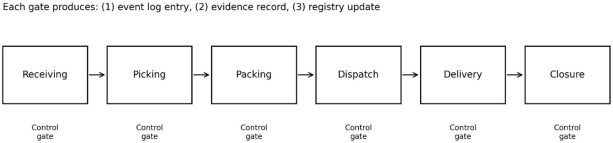
Fig. 2. Standard work control points across receiving-to-closure
Traceability is achieved through event logging and document indexing at shipment level rather than through a monolithic WMS. World Bank traceability guidance illustrates common event types (shipping and receiving events between locations) supporting external traceability. This layer defines the minimal KPI set computed from the registry (OTIF, event completeness, document completeness, exception aging) and a governance cadence (weekly exceptions review, monthly SOP updates). OTIF is increasingly treated as a foundational reliability KPI in distribution contexts.
4. Operational Data Model: The Shipment Registry and standard Work Checklists and Control Points
The shipment registry is a “single operational truth table” integrating: shipments, lines, event logs, document index, and exception ledger. It can be implemented using spreadsheets, low-code databases, or lightweight SQL, provided governance rules are enforced.
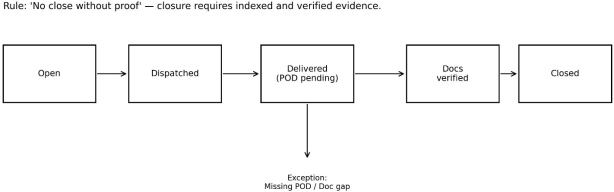
Fig. 3. Document packet closure workflow (“no close without proof”)
Standard work is expressed as concise checklists aligned to control points and registry updates. This is the “process skeleton” that makes event logging reliable.
Table 1
WMS vs. WMS-light (lean digitalization) comparison
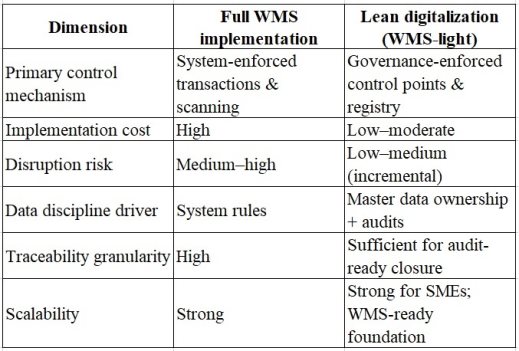
Table 2
Minimal KPI set (registry-derived)
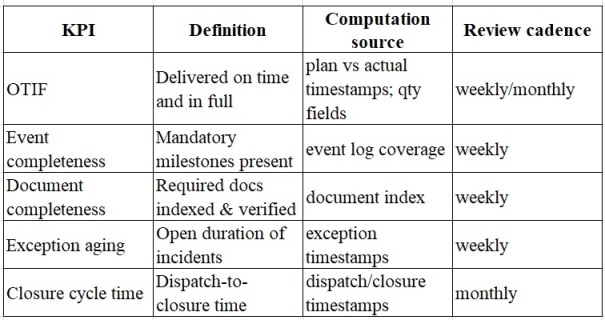
Table 3
Standard work checklist matrix (control points)
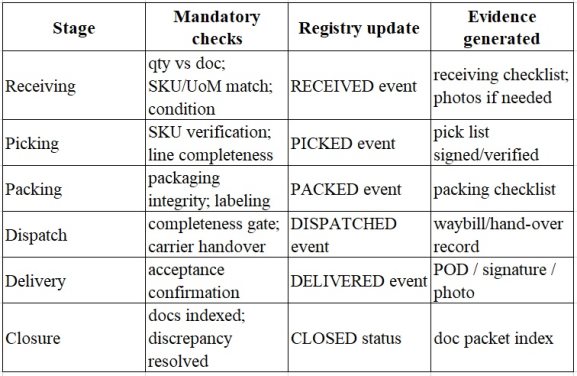
5. Incident Taxonomy and Exception Governance
Incidents must be classified to become governable signals. The taxonomy is intentionally compact to fit SME capacity.
Proposed taxonomy:
– Delay (missed delivery window, no carrier update);
– Quantity discrepancy (shortage/excess, wrong SKU/UoM);
– Damage (packaging breach, broken pallet, compromised integrity);
– Documentation gap (missing POD, missing invoice linkage, missing waybill elements);
– Data integrity error (wrong master data, duplicate shipment ID, registry mismatch).
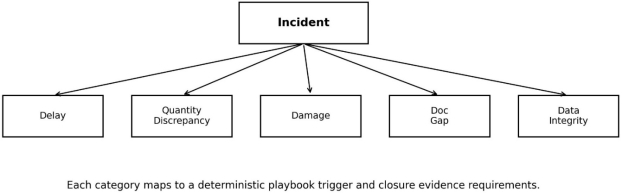
Fig. 4. Incident taxonomy (compact categories for SMEs)
Severity levels:
– S1 (minor, no customer impact);
– S2 (service impact, recoverable);
– S3 (contract/compliance risk);
– S4 (financial/legal risk).
This structure supports deterministic playbook triggers and aligns with audit-oriented governance logic (including audit program principles described by ISO 19011).
6. Risk & Playbooks (embedded control subsystem),core playbooks for SME logistics operations
Risk and exception handling is operationalized via deterministic playbooks aligned with risk management guidance. ISO 31000 provides a general process for identifying, analyzing, treating, and monitoring risks, while ISO 22301 frames continuity and recovery readiness as organizational resilience capabilities. In SME logistics, playbooks convert frequent operational uncertainty into repeatable routines.
Each playbook includes:
– trigger condition (registry-derived),
– initial containment action,
– escalation path and roles,
– customer/partner communication template,
– evidence requirements
– closure criteria.
The following core playbooks are designed to be sector-neutral and applicable across multi-category distribution (construction materials, regulated goods, and general goods). Each playbook is triggered by registry-detectable conditions and ends with objective closure evidence requirements to maintain audit readiness.
Playbook A — Regional delay / missed delivery window. Trigger: planned_delivery_ts is exceeded and no verified carrier update milestone is logged within a defined threshold. Actions: request ETA, record update, notify consignee, evaluate rerouting or carrier swap if the ETA breaches escalation thresholds. Closure evidence: updated ETA record, customer notification log, delivery confirmation and proof-of-delivery (POD) indexed.
Playbook B — Quantity discrepancy (shortage/excess/wrong SKU or unit-of-measure). Trigger: qty delivered differs from qty planned or verification gate fails at receiving/delivery. Actions: freeze closure, perform recount, isolate disputed items, generate adjustment act, and reconcile registry line items. Closure evidence: signed adjustment act, photo evidence if required, updated registry lines, and supervisor verification.
Playbook C — Damage / packaging integrity breach. Trigger: DAMAGE incident logged at receiving or delivery, or packaging checklist fails. Actions: quarantine goods, assess usability, initiate claim workflow with carrier/supplier where applicable, and document disposition decision. Closure evidence: damage report, claim correspondence, disposition record, and customer resolution note.
Playbook D — Missing POD / documentation gap. Trigger: DELIVERED milestone recorded without POD indexed within a defined window, or required document types remain missing for closure. Actions: block closure state, request POD from carrier/customer, re-issue document packet checklist, and escalate repeated gaps via partner governance. Closure evidence: POD indexed and verified, document packet checklist completed, closure state updated.
Playbook E — Data integrity error (master data or registry mismatch). Trigger: SKU identifier mismatch, unit-of-measure mismatch, duplicate shipment id, or inconsistent partner codes causing reconciliation failures. Actions: stop postings for affected entity, open data incident, apply controlled correction with audit trail, and communicate updated master data. Closure evidence: before/after master-data snapshot, correction ticket, audit log entry, and reconciled transactions.
7. Escalation ladder and closure discipline,Implementation Blueprint (90-day and 180-day)
To reduce subjective decision-making, playbooks operate under a four-level escalation ladder: Level 1 (operational correction, same-day containment and logging), Level 2 (supervisor review and evidence verification), Level 3 (manager escalation for carrier actions, rerouting decisions, and contractual remedies), and Level 4 (policy/SOP revision and retraining). The ladder is activated by objective thresholds such as exception aging, repetition frequency, severity category, or compliance risk flags.
A central cross-playbook rule applies: “no close without proof.” A shipment is not considered completed until required evidence is indexed and verified and any open exceptions are reconciled with documented closure evidence. This discipline operationalizes risk management guidance (e.g., ISO 31000 risk process and ISO 22301 continuity principles) within registry-driven workflows rather than treating risk as a separate managerial narrative.
Implementation is staged to reduce disruption and build adoption capability, consistent with SME digitalization guidance emphasizing training, governance maturity, and incremental uptake.

Fig. 5. 12-week (90-day) roadmap
Phase outcomes:
– Master data baseline established and owned;
– Shipment registry operational;
– Document closure workflow enforced;
– Incident taxonomy and weekly exception review active;
– Minimal KPI set computed from registry.
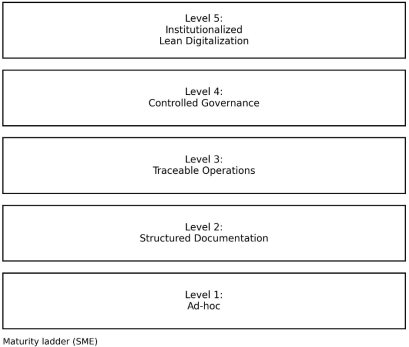
Fig. 6. Governance maturity model (staged adoption for SMEs)
Second-stage outcomes:
– Partner interfaces standardized (carrier SLA scorecards, POD discipline)
– Monthly SOP revision cycle institutionalized
– Audit routines established (spot-checks, closure aging review)
– Optional lightweight integration with ERP/IS ESF APIs planned where feasible (without assuming full integration from day one)
Kazakhstan’s SRC/KGD notes the existence of API interfaces enabling integration of IS ESF/Virtual Warehouse with ERP systems, supporting the feasibility of staged integration once internal governance is stabilized. A small synthetic evaluation demonstrates registry outputs and playbook triggers.
Table 4
“Illustrative example”: Registry outputs from 100 shipments
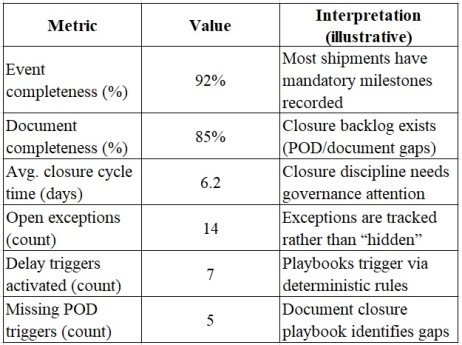
8. Kazakhstan Context
The model reflects a common operational geometry in Kazakhstan: a primary warehouse located in Almaty with distribution to city customers and multiple regions. The operational risks in such a network include lead-time variability, carrier heterogeneity, and documentation closure delays, all of which amplify the value of event-based traceability and deterministic governance routines.
The SRC/KGD describes the Virtual Warehouse module as a subsystem of IS ESF intended to systematize goods accounting, automate balance calculations, and store electronic documents for receipt, movement, and write-off of goods; it also notes that an API interface enables integration with ERP/accounting systems.
The same institutional ecosystem includes mandatory electronic invoicing for VAT payers. The SRC/KGD press release states that from 2019 VAT payers are required to issue electronic invoices via the e-invoicing information system. The SRC also provides an e-invoicing section noting API interface advantages and registration steps.
Regulatory timeline relevant to logistics governance (high-level)
– 2018: Virtual Warehouse module introduced within IS ESF framework and described as storing goods movement documents and enabling online balance tracking;
– 2019: Electronic invoicing mandatory for VAT payers per SRC press release;
– 2023: SRC communications indicate API authentication updates for IS ESF, reflecting ongoing platform evolution;
– 2026 (effective 1 January): New invoice rules and form approved by Order No. 629 of the Minister of Finance (official legal references and summaries.
This evolving regulatory context reinforces the argument that SMEs benefit from a governance-first traceability architecture that can later integrate with institutional APIs, rather than relying on ad hoc paper closure.
The proposed artifact set provides a bridge: it enables SMEs to institutionalize traceability and closure using lightweight tooling and governance discipline, while remaining compatible with broader traceability direction such as GS1 Sunrise 2027 (2D barcode readiness) and GS1 Digital Link’s ability to encode identifiers and attributes (batch/expiry/serial) into web-resolvable structures.
In emerging markets like Kazakhstan, where digital invoicing and goods traceability infrastructure is developing at institutional level, this approach reduces SME exposure to compliance and dispute risk by ensuring shipments are reconstructable through evidence.
Conclusion
SME logistics operations in emerging markets can achieve audit-ready traceability without a full WMS by implementing a governance-first lean digitalization control stack: master data ownership, standard work control points, shipment registry event logging with document indexing, minimal KPI governance loops, and deterministic risk playbooks. Kazakhstan’s progression toward digital invoicing and Virtual Warehouse traceability infrastructure increases the value of such an approach, as it reduces evidence gaps and strengthens closure discipline.
References:
- ISO. ISO 31000:2018 — Risk management — Guidelines. Retrieved February 2026 from https://www.iso.org/standard/65694.html
- OECD. (2021). The digital transformation of SMEs. https://www.oecd.org/content/dam/oecd/en/publications/reports/2021/02/the-digital-transformation-of-smes_ec3163f5/bdb9256a-en.pdf
- https://kgd.gov.kz/ru/content/virtualnyy-sklad-1
- KGD (State Revenue Committee of Kazakhstan). (2019). All VAT payers are required to issue electronic invoices (press release). Retrieved Feb 2026. https://kgd.gov.kz/en/news/all-vat-payers-are-required-issue-electronic-invoices-1–38899
- https://www.oecd.org/content/dam/oecd/en/publications/reports/2021/02/the-digital-transformation-of-smes_ec3163f5/bdb9256a-en.pdf
- https://www.sciencedirect.com/science/article/pii/S2444569X25000733
- Tubis, A. A., et al. (2023). Intelligent warehouse in Industry 4.0-Systematic literature review. Sensors, 23(8), 4105. https://www.mdpi.com/1424–8220/23/8/4105
- https://ideas.repec.org/a/gam/jlogis/v7y2023i2p24-d1122277.html
- Julião, B. J. B., et al. (2025). A systematic lean-driven framework for warehouse optimization. Systems, 13(9). https://www.mdpi.com/2079–8954/13/9/813
- https://www.sciencedirect.com/science/article/pii/S2444569X24001379
- Budler, M., et al. (2024). A review of supply chain transparency research. Journal of Business Logistics (Wiley). https://onlinelibrary.wiley.com/doi/10.1111/jbl.12368
- World Bank. (2024). Digital technology for traceability: event type definitions (Shipping/Receiving). https://documents1.worldbank.org/curated/en/099724310182330688/pdf/IDU03bd6b7680aa0804d260a4120c0c008620286.pdf
- https://www.mdpi.com/2071–1050/15/21/15212
- https://www.mdpi.com/2078–2489/17/1/46
- https://www.oecd.org/content/dam/oecd/en/publications/reports/2025/06/oecd-supply-chain-resilience-review_9930d256/94e3a8ea-en.pdf
- https://kgd.gov.kz/en/news/all-vat-payers-are-required-issue-electronic-invoices-1–38899
- Peffers, K., Tuunanen, T., Rothenberger, M. A., & Chatterjee, S. (2007/2008). A design science research methodology for information systems research. Journal of Management Information Systems, 24(3), 45–77. https://indico.cern.ch/event/1542774/contributions/6494311/attachments/3080345/5465431/Peffers_2007_A %20Design %20Science %20Research %20Methodology %20for %20Information %20Systems %20Research.pdf
- https://www.oecd.org/content/dam/oecd/en/publications/reports/2021/02/the-digital-transformation-of-smes_ec3163f5/bdb9256a-en.pdf
- https://www.mdpi.com/2227–7390/12/21/3372
- https://www.iso.org/standard/70017.html
- https://www.oecd.org/content/dam/oecd/en/publications/reports/2021/08/smes-going-digital_3b1e76c1/c91088a4-en.pdf
- https://kgd.gov.kz/ru/content/virtualnyy-sklad-1
- KGD (State Revenue Committee of Kazakhstan). (2018). Virtual Warehouse module description (IS ESF). Retrieved Feb 2026. https://kgd.gov.kz/ru/content/virtualnyy-sklad-1
- https://kgd.gov.kz/en/section/elektronnye-scheta-faktury
- SRC/KGD. (2023). API authentication changes for IS ESF (press release). Retrieved Feb 2026.
- On Approval of the Rules for Issuing an Invoice and Its Form https://adilet.zan.kz/rus/docs/V2500037241
- https://www.gs1us.org/industries-and-insights/by-topic/sunrise-2027