В статье рассматриваются нефтегазообразовательные стратиграфические комплексы мезозойско-кайнозойского разреза Каспийско-Губинского нефтегазового района. Целью исследования является определение основных интервалов материнских пород и их роли в генерации углеводородов на основе геологических, геохимических и геофизических данных ранее проведённых региональных исследований. Основное внимание уделено стратиграфическому положению, литологическому составу и термальным условиям мезозойских и кайнозойских отложений.
Полученные результаты показывают, что генерация углеводородов преимущественно связана с глинистыми мезозойскими и кайнозойскими комплексами, обогащёнными органическим веществом. Юрские, меловые, палеогеновые и миоценовые отложения участвуют в формировании нефтегазовых систем, при этом майкопская серия представляет собой один из наиболее важных интервалов материнских пород. Распределение зон генерации углеводородов определяется глубиной погружения, геотермическим режимом и тектонической эволюцией бассейна. Полученные результаты могут быть использованы для уточнения представлений о нефтегазовых системах и повышения эффективности геологоразведочных работ в Каспийско-Губинском нефтегазовом районе.
Ключевые слова: Каспийско-Губинский нефтегазовый район, генерация углеводородов, стратиграфические комплексы, мезозойско-кайнозойский разрез, материнские породы.
Introduction
The study of hydrocarbon-generating stratigraphic complexes is essential for understanding the formation and distribution of oil and gas accumulations in sedimentary basins. Source rocks control the volume and type of hydrocarbons and depend on lithological composition, organic matter content, burial depth, and thermal regime. The Caspian-Quba oil and gas province is characterized by a thick Mesozoic-Cenozoic sedimentary succession and complex tectonic evolution, which created favorable conditions for hydrocarbon generation and accumulation. Previous geological and geochemical studies indicate that several stratigraphic intervals within the Mesozoic and Cenozoic section possess significant generation potential. Jurassic, Cretaceous, Paleogene, and Miocene deposits, including the Maikop series, contain organic-rich clay formations that act as the main source rocks of the province. However, the contribution of individual stratigraphic complexes to hydrocarbon generation and their spatial distribution remain insufficiently clarified. The purpose of this study is to analyze the hydrocarbon-generating stratigraphic complexes of the Caspian-Quba oil and gas province and to assess their role within the regional petroleum system.
Objective
The main objective of this study is to identify and characterize the hydrocarbon-generating stratigraphic complexes of the Mesozoic-Cenozoic succession within the Caspian-Quba oil and gas province. The research focuses on determining the stratigraphic position, lithological features, and generation potential of the main source rock intervals based on available geological, geochemical, and geophysical data.
Another objective is to evaluate the role of tectonic development and thermal conditions in controlling hydrocarbon generation and distribution within the basin. The study aims to clarify the contribution of individual stratigraphic complexes to the regional petroleum system and to provide a basis for improving exploration assessment in the Caspian-Quba oil and gas province
Methods
The methodological basis of this study relies on an integrated analysis of geological, geochemical, and geophysical data previously obtained for the Caspian-Quba oil and gas province. The research uses a regional approach that combines stratigraphic interpretation, lithological analysis, organic matter assessment, and thermal maturity evaluation. This approach allows identification of hydrocarbon-generating stratigraphic complexes and assessment of their role in the petroleum system of the basin.
Burial history was reconstructed qualitatively based on stratigraphic thickness, sedimentation rate, and tectonic subsidence patterns described in regional geological studies. This reconstruction allowed assessment of the timing of hydrocarbon generation relative to trap formation and migration processes. The influence of rapid subsidence during the Cenozoic was considered as a key factor controlling the maturation of deeper Mesozoic source rocks.
Geophysical methods played an important role in identifying the spatial distribution of hydrocarbon-generating complexes. Seismic reflection data from published sources were used to analyze the structure of the sedimentary cover and to identify major stratigraphic boundaries and fault zones.
Gravity and magnetic data from regional studies were also considered to characterize deep structural features and basement configuration.
The final stage of the methodology involved integration of geological, geochemical, and geophysical results into a unified petroleum system framework. Hydrocarbon-generating stratigraphic complexes were identified by combining information on lithology, organic matter content, maturity level, and burial conditions.
The stratigraphic framework of the study is based on regional stratigraphic schemes developed for the Azerbaijan sector of the Caspian region and adjacent onshore areas. The Mesozoic-Cenozoic succession was subdivided into major stratigraphic units according to age, lithological composition, and depositional environment. Special attention was given to Jurassic, Cretaceous, Paleogene, and Miocene intervals, as these units are widely considered potential source rock complexes.
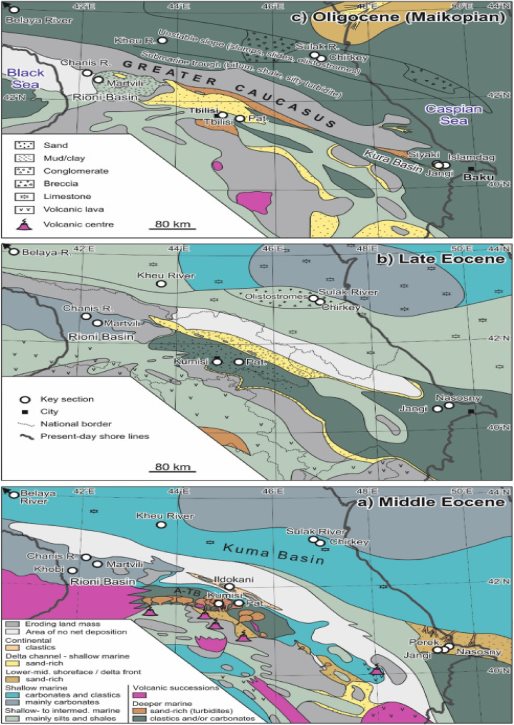
Fig. 1. Paleogeography of the Caucasus area during a) Middle Eocene, b) Late Eocene, and c) “Maikopian” (Oligocene) time (Blackbourn et al., 2021)
Lithological descriptions from exploration and appraisal wells were used to determine the vertical distribution of clay, carbonate, and terrigenous rocks. These data were supplemented by published descriptions of outcrops in structurally uplifted zones of the region. Clay-rich intervals with fine-grained texture were selected as the primary objects of hydrocarbon generation analysis, since such lithologies favor the accumulation and preservation of organic matter.
The assessment of hydrocarbon-generating potential was based on published geochemical data, including total organic carbon values, kerogen type descriptions, and pyrolysis parameters.
Source rocks were classified according to their organic matter richness and hydrocarbon generation capacity. Clay and carbonate-clay sediments with moderate to high organic carbon content were considered effective source rocks.
Thermal maturity indicators, such as vitrinite reflectance values and Tmax data, were used to assess the degree of organic matter transformation. The maturity assessment helped to distinguish immature, oil-generating, and gas-generating zones within the stratigraphic succession. The thermal regime of the Caspian-Quba oil and gas province was evaluated using published geothermal gradient data and temperature measurements from wells.
Each stratigraphic complex was evaluated in terms of its generation potential, spatial distribution, and contribution to known oil and gas accumulations. The genetic relationship between source rocks and reservoirs was assessed using regional migration concepts and structural analysis. Vertical and lateral heterogeneity of hydrocarbon generation zones was analyzed to explain variations in hydrocarbon type and field distribution across the province. The methodological approach emphasizes the use of verified regional data and established geological concepts. This ensures that the results are consistent with existing knowledge while providing a refined understanding of hydrocarbon-generating processes in the Caspian-Quba oil and gas province. The applied methods can also be used as a basis for further basin modeling and exploration planning in similar geological settings.
Conclusion
The conducted analysis shows that the hydrocarbon potential of the Caspian-Quba oil and gas province is closely related to hydrocarbon-generating stratigraphic complexes of the Mesozoic-Cenozoic succession. Clay-rich Jurassic, Cretaceous, Paleogene, and Miocene sediments, especially the Maikop series, represent the main source rock intervals due to favorable organic matter content, burial depth, and thermal conditions. The obtained results confirm the important role of stratigraphic position and basin evolution in hydrocarbon generation and can be used to improve regional petroleum system understanding and exploration assessment.
References:
- Buryakovsky L. A., Aminzadeh F. Petroleum geology of the South Caspian Basin. Gulf Professional Publishing, 2001, 464 p.
- Guliyev I. S., Federov D. L., Kulakov S. I. Oil and gas potential of the Caspian region. Baku, 2009, pp. 25–38.
- Kagramanov K. N., Mukhtarova Kh.Z., Shpyrko S. G., Babaev M. S. Geothermal conditions of oil and gas content of the Mesozoic–Cenozoic complex of the South Caspian Basin. Geophysical Journal, 2019, Vol. 41, No. 5, pp. 222–234.
- Khalilova L. N., Seidov V. M. Evolution of hydrocarbon deposits in the South Caspian Basin. Geophysical Journal, 2023, Vol. 45, No. 3, pp. 126–134.
- V. Aghayeva, R. F. Sachsenhofer, C. G. C. van Baak, Sh.Bayramova, S. orić, M. J. Frühwirth, E. Rzayeva, S. J. Vincent. Stratigraphy of the Cenozoic succession in eastern Azerbaijan: Implications for petroleum systems and paleogeography in the Caspian basin. Marine and Petroleum Geology, Volume 150, April 2023, 106148
- Mukhtarova Kh.Z. Influence of geotectonic processes on geological development and oil and gas content of the South Caspian depression. Geology, Geophysics and Development of Oil and Gas Fields, 2021, No. 9, pp. 14–21.
- Narimanov N. R., Kahramanov K. N., Babaev M. S., Nasibova G. C. Influence of the geodynamic regime of the South Caspian Basin on oil and gas content. Azerbaijan Oil Economy, 2019, No. 8, pp. 9–14.
- Salmanov A. M., Suleymanov A. M., Maharramov V. I. Paleogeology of oil and gas regions of Azerbaijan. Baku, 2015, 471 p.
- Suleymanov A. M. Lithological and stratigraphic prerequisites for oil and gas prospecting in Mesozoic sediments of Azerbaijan. Geologist of Azerbaijan, 2000, No. 4.
- Suleymanov A. M., Akhudov Sh.H. Structural and paleogeographic development of the Cretaceous–Paleogene sedimentary complex of the Kura region. Baku: ANE, 2003, 11 p.
- US Geological Survey. Oligocene–Miocene Maykop/Diatom Total Petroleum System of the South Caspian Basin. USGS Bulletin 2201-I, 2001.